Showing posts with label Ficus Natalensis. Show all posts

Tuesday, 19 May 2020

Is my Ficus Fusion Project Dying?

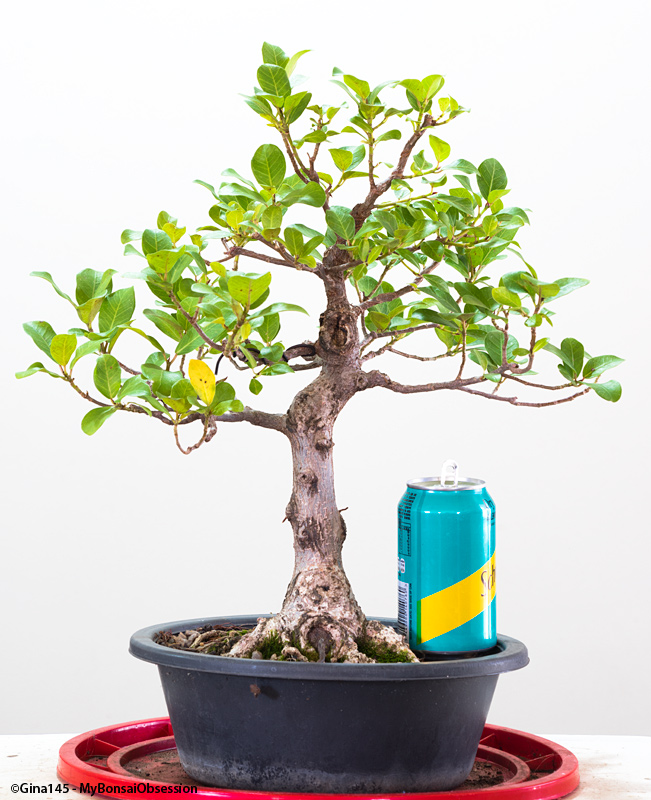
The tree as it looks today (front view)

Everything was going so well with the Fusion Project which I've been developing from a bunch of Ficus Natalensis cuttings over the last four and a half years.

I was finally happy with the way the trunk was fusing and had started some styling work.

In the period up to January 2020 I took it to a couple of meetings looking for advice.

January 2020 - before pruning

A few people felt that the first branch (the thick one, above the cutting I've planted to try to widen the trunk) should be removed, but I didn't like that idea and chose to shorten it instead. I also felt the tree was getting rather top heavy, so I cut it back to a new leader.

January 2020 - after pruning

For a while everything seemed fine but the first signs of trouble appeared sometime in March, shortly before lockdown. I have a photo showing serious die-back which was taken on 27 March. That was the day I decided to remove the dead leaves, but leave the branches intact in case some of them survived.

At the time I thought that a badly executed cut had killed the top and I wasn't too concerned about it as the tree was taller than I wanted it to be anyway. I was unaware of any further problems after that.

A couple of weeks ago, when the first signs of winter appeared, I moved the tree into my greenhouse.

Then this morning, I noticed a whole new section of dying leaves.

Best case scenario here is that I'm going to have a much shorter tree than I'd planned. To be honest I'd be quite happy with that.

But right now I'm terrified that this is just the beginning of the problem and that the tree is dying. And right now, with the Covid-19 pandemic in full swing, I'm unable to take the tree anywhere to ask for advice.

If anyone reading this can offer me some assistance, it will be most welcome. I've put a lot of effort into creating this tree and I'd hate to lose it.

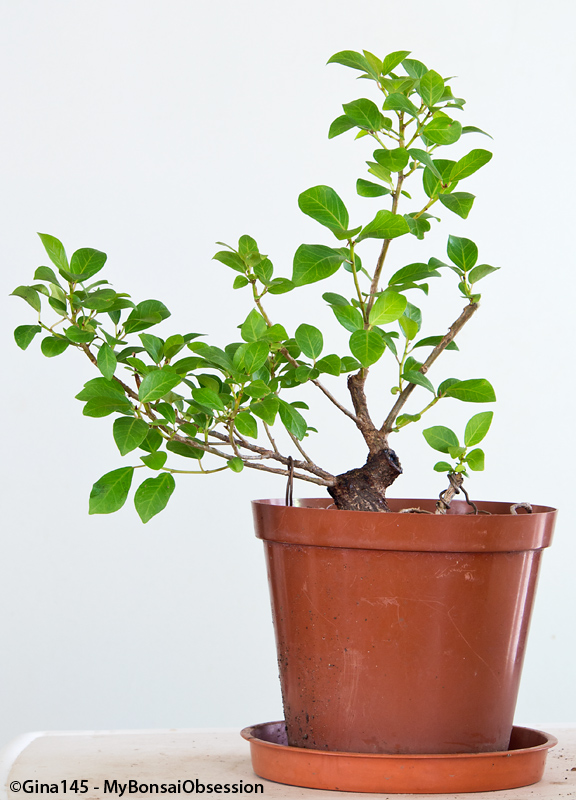
The tree as it looks today (back view)


Tuesday, 5 March 2019

The Second Ficus

Yesterday's post was all about the first of my two neglected ficuses, a tree which had benefited greatly from the development of a vigorous and totally unplanned sacrifice branch.

At the time I had not yet done anything to its sibling aside from removing a few dead branches. I've just finished working on that one - it received much harsher treatment than yesterday's tree because the trunk was long and straight with very little taper.

Ficus Natalensis - March 2019

I started by removing the top section, which left potential for something approximating a formal upright tree:


I contemplated stopping there. However I'm trying to focus on short fat trees rather than tall skinny ones, so I knew I wouldn't be happy with that in the long term.

In the end I stuck to my original plan and cut to the lowest branch, leaving what is currently a very ugly tree.

March 2019 - after the chop

No point in wiring that branch because I don't plan to use it as a leader. It's just a sacrifice branch which will be removed along with approximately half the trunk once I get growth where I really want it.

Both trees - March 2019

I can't wait to see what these trees look like a year from now.


Monday, 4 March 2019

The Benefit of Neglect

I hate to admit that the last time I worked on my two neglected ficuses was when I repotted them in November 2015. Because of time constraints only one ever made it into my previous blog post and once again that's the only one I've had time to work on so far. Coincidentally, for the moment it's the better tree.

In November 2015 that tree looked like this:

Ficus Natalensis - November 2015

A few sharp bends and hardly any taper!

Although my neglect means that the trees are no closer to being bonsai than they were three years ago, the move to bigger pots has allowed them to grow big and tall and their trunks have fattened up considerably. Unfortunately the top growth has blocked light from the lower part of the trees and as a result, both have lost some lower branches. The tree above also developed a massive low branch which grew upwards, reaching a height  twice that of the intended apex.

Same tree - March 2019

Under the circumstances I found myself having to treat it as nursery stock when I took it to a workshop on Saturday afternoon.

First I had to get both trees out of the greenhouse though, and that proved to be quite a mission as once again one had sent a root into the other one's pot and both had also sent roots through the slats of the shelf they were living on. To complicated matters further, the neighbouring orchid (a gift which I tend to ignore) had sent roots into both pots. That meant there were quite a lot of roots that had to be cut before I could move the trees.

Once at the workshop the first step was to remove that huge branch.

After removing the huge branch

The tree was already looking better but it was rather top heavy, with a leader growing in the wrong direction. The club member I was working with recommended I cut back to a new leader, advice I was happy to follow, as I'd already said in 2015 that "At a later stage I might reduce the height further".

March 2019 - after pruning

As it's still in the same pot, the change in the thickness of the trunk is pretty obvious.

I've left all the aerial roots for now as we're headed into winter. I'll decide whether to keep any of them when I repot the tree in spring - as long as I don't forget!!

As for the second tree, it looked like this when I removed it from the greenhouse:

Second tree - March 2019

I've removed a few dead branches so far and plan to cut it back to the lowest living branch, then wait for back budding before cutting in to a more suitable height. I'd like to make a short, fat little tree from this one.

Thursday, 13 December 2018

How to Ruin a Bonsai Without Really Trying

The first tree to appear in my blog was this Ficus Natalensis which I grew from a cutting in 2007.

Ficus Natalensis - September 2015

As an overenthusiastic newbie I made a lot of mistakes with this one, but in 2010, when I moved it into a bonsai pot and put it on show for the first time, I was really proud of my little tree.

In recent years however I've been trying to correct some of my early mistakes, so in November 2015 I moved it back into a training pot.

The idea was right, but it was a plan poorly executed. After initially pruning too hard, undoing the good growth that took place during its first couple of months in the training pot, I went to the other extreme, forgetting to prune it at all.

December 2018 - unpruned

After a quick pruning, there's some resemblance to the tree it once was.

December 2018 - after pruning

All that new growth has done some good, fattening up the trunk and reducing the reverse taper I was so concerned about in 2016.

Reverse taper - August 2016

Improved base - December 2018

Unfortunately all that vigorous growth has created a new problem. Some of the lower branches weren't getting enough light, leading to significant die-back. The second branch appears to be dead.

Dead branch

The tree won't look right without it.

In one of my 2016 posts I said:
"At times I've contemplated giving this tree a whole new look but a part of me feels I should stick to the original plan to show how my sense of style has evolved over the years."
Now, without that branch, I'm starting to think that a total makeover may be the best way forward.

Monday, 14 May 2018

Growing Big Trees from Small Cuttings

A member of Reddit's bonsai group recently asked me this question:

"What's the thickest you've ever got a tiny cutting up to? Guess I'm wondering what 10 years can do!"

The simple answer is that I made the decision early on  to restrict myself to trees and pots that I'm able to carry unassisted. As a small woman, that limits my ability to grow big trees. Still, some of them have reached a decent size over the years and if it hadn't been for some beginner's mistakes, they would have done even better.

Let's start at the beginning.


May 2018

My first Ficus Natalensis cutting serves as a good lesson in how NOT to grow a decent trunk. Yet I was once proud enough of this tree to publish an article about its early development at HubPages. That was long before I ever dreamed of starting my own blog.

I guess it works if you're new to bonsai and you're happy to grow a skinny little tree. Provided you're working with a fast growing species, that is!

After several years in a bonsai pot, this tree has been back in a training pot for over two years now but it's not making as much progress as I'd like. It doesn't help that I rarely think to rotate my trees. The back of this one was close to a wall and it now has quite a bit of die back on the lowest branches. I'll have to work on fixing that next summer.

Measurements:
9cm across the usable nebari (some roots are badly in need of pruning)
5cm just above the roots
Height 34 cm

Sometimes I'm tempted to give this one a total revamp, though probably not what I suggested a few months back. But when I think about it, I tell myself that I should stick to its original styling as a reminder of how I got started in bonsai.

This one is slightly more impressive.


May 2018

I'm guessing that it's approximately 9 years old, though I haven't had a chance to check all my old photos.

Most of the trunk growth occurred quite early in its life, before I made some styling choices I've come to regret. How I wish I'd never removed the lower branches. But what's done is done.

Measurements:
13cm across the nebari
6cm just above the roots
Height 41 cm

I'm seriously tempted to do an air layer here as I think there's good potential for a smaller tree using the top and I can make a short fat one with the bottom part.

The next one has mostly been allowed to grow unchecked.


May 2018

I'm not sure how old this one is, but it's younger than the other two.

Again I made one cut early on that I now regret. Other than that I've done little pruning, only shortening some branches from time to time. In my crowded bonsai area some of the lower branches haven't been getting enough light though and there's quite a bit of die back. That's not really an issue when it comes to styling because this tree has a trunk chop in its future - probably in the form of an air layer as early as next spring.

I recently discovered an aerial root at the bend which will make the trunk even more impressive when it fattens up.

Close view showing aerial root - May 2018

I'm not sure if I'll still be able to reposition it - I'll have to see about that when the air layer is done.

Measurements:
10-12cm across nebari - depending on final choice of front
6-7cm above roots - exclusing aerial root
Height 99cm

And then there's the easy way.


Fusion project detail - May 2018

If you don't want to wait years for a trunk to fatten up, fuse several cuttings to create one fat tree. My project is relatively small, but that's only because I couldn't cope with anything much bigger. If you've got lots of cuttings and can cope with big trees, the results can be really impressive.

Measurements:
6.5 cm across roots
Height 61cm

I'm sure this one could already have been quite a bit bigger if I hadn't left it in my greenhouse for two years. One summer outside has made a big difference.


Saturday, 24 February 2018

The Fusion Project

In August 2015 I decided to fuse some of my long, straight Ficus Natalensis cuttings together to create one larger tree.

In order to plant them close together a lot of root pruning was required. Some had fairly substantial roots, so I was able to keep a few of the thickest ones to grow as root cuttings. The two resulting trees are doing well, but I'll discuss those another time.

Once potted I bound the bases together with self-adhesive tape. I'm not sure why I didn't bind them higher up as well, but once done I had this as my starting point:

August 2015

The base looked like this:

August 2015 - detail

As the nights were still cold (August is the end of winter here) I put them back in my greenhouse and due to space constraints they remained there for the next couple of years.

By November 2016 they were growing strongly, but when I removed the tape they were showing no signs of fusing:

November 2016 - detail

I replaced the tape, adding more higher up on the trunk, but didn't think to add movement. Here they are in December 2016:

December 2016

Finally in May 2017 I realised my mistake and tried to wire some movement into them, but after wrapping thick wire around them I found I was unable to bend the wire as much as I wanted to, so I took them to a workshop where my mentor did the muscle work for me.

Wired - May 2017

And in spring 2017 I finally moved them out of the greenhouse into a sunnier spot.

When the wire started biting I removed it and got help in rewiring them to ensure the curves didn't bounce back to their original position. After the wire started biting a second time I decided it was no longer required. This photo was taken a few days ago, several weeks after the wire was removed.

February 2018

Close-up photos show good fusion in some places:

February 2018 - detail of lower trunk

However, in other parts there are still big gaps:

February 2018 - detail of upper trunk with gaps

I added extra tape to this area, so hopefully the gap will soon close.

February 2018 - gap taped

There are a couple of additional photos here. More photos will be added to that page as the tree develops.

Hopefully by next summer the trunk will have developed well enough for me to start thinking about branch selection.

Sunday, 11 February 2018

Which is the best front?

I thought I had my clip and grow Ficus Natalensis all sorted out. It's been hard work getting it to where it is without ever using wire, but over time it's filled out nicely. It's come a long way since this old photo from late 2015:


This summer I've been concentrating entirely on ramification, giving it only the occasional rough haircut to encourage as much back budding as possible. By this week it had grown so full that the trunk was hardly visible any more:

February 2018 - before pruning

Yesterday's club meeting was of a practical nature and we were asked to bring along trees for discussion or work, so I took the little guy along to see if I could get some new ideas that might improve it. I decided to allow the speaker to prune the tree, instructing him only that no wiring was allowed. He didn't do anything too drastic, or so I thought.

February 2018 - after pruning

Because the trunk had been hidden behind foliage for so long, it was only when I got home that I realised that this wasn't my front. My intended front currently looks like this, with a stick inserted to pull back some of the foliage that's still blocking the view:

February 2018 - current view of my intended front

Now I'm confused. His trunk line actually looks good, but there's an issue with the nebari. From my intended front, the tree has a fairly solid base, though the root on the left could do with a bit of thickening.


From his front, the trunk below the bend is rather straight and the roots aren't great. The left one is really weak and the thicker root on the right is badly positioned, meaning I might have to remove it in favour of the weaker one:


Still, that can be fixed. For now I'm considering raising the soil level to see if those roots fatten up. I hope they do, because I think the branch structure probably is better from his chosen front.

A little bit of wiring would have everything so much simpler!

Monday, 4 December 2017

A New Option for an Old Ficus

When I joined my club in late 2007 I got rather bogged down by the rules for branch placement and for a while it seemed that I was trying to turn every tree into the "perfect" informal upright. It was only a couple of years later when I was looking for candidate trees to put on the club show that I realised that my more developed trees all looked very similar. That didn't make me very happy.

Over the years I've slowly learned to do things differently and some of the trees from my early days are now undergoing radical transformations. However the Ficus Natalensis I started as a cutting shortly before I joined the club is still very much on the path I first set out for it.

After time spent in a bonsai pot I moved it back into a training pot in November 2015 but all the new growth hasn't made a great difference and I'm still not happy with its overall appearance:

November 2017

During a routine haircut a new idea came to me. I'm contemplating removing the first branch, changing the slant ever so slightly and flattening the knob at the first bend. I'm not going to rush into making any drastic changes that I may come to regret though. That's why for now the only restyling was done in Photoshop.

Virtual pruning in Photoshop

What would you do if this was your tree?

Thursday, 21 September 2017

Facing My Fears

Spring is my favourite time of the year. I loving seeing my trees coming out of dormancy and being transformed into a sea of green, with lots of fresh young leaves free from the blemishes that our summer hailstorms will eventually create.

But it's also a time I fear because I've never become totally comfortable when it comes to repotting trees - especially not when it comes to downsizing from a training pot to a proper bonsai pot. I think a part of that stems from a workshop I attended early in my bonsai days.

One of our club members brought along a tree which was in serious trouble. One side looked reasonably healthy but the other side was dying. On close inspection it was discovered that the trouble came from the roots. There was a large air pocket in the soil which prevented some of the roots from getting the moisture they required. I'm not sure what became of that tree but it's haunted me ever since.

I had big plans for this spring though, but things haven't quite gone to plan. August (still officially winter) got off to a really warm start and around the middle of the month I pruned this newly acquired nursery tree and moved it from its black bag into a training pot.

Ligustrum Ibota - August 2017

It's slowly showing signs of new growth but most of the new buds aren't where I hoped they'd be. In fact the thin branch on the left now has no foliage at all and I fear I may lose it. But more about this tree in another post - when I have something to work with. For now I'm playing a waiting game.

Shortly after I potted this tree we were hit by a cold snap, so I decided to wait for the weather to warm up a bit before I continued my repotting efforts.

And then, just as the weather warmed up again, our landline and internet connection suddenly stopped working.

Okay, I hear you thinking, loss of technology should be the perfect opportunity to give my trees my full attention. But no, as I battled to get the problem fixed, I seemed to be constantly sitting at home waiting for repairmen who never arrived. I was afraid to get my hands dirty in case the doorbell rang at an inopportune moment. And every time the problem was fixed, I found myself playing catch-up with my online activities, so I still had little time for my trees. As a result, to date I've only managed to repot a handful of trees and, with most of my deciduous trees now covered in leaves, I fear many of those I'd planned to work on will be remaining in the same soil for another year.

One of the trees that topped my list of priorities however was one of my favourites - a little Ficus Natalensis which has appeared in several of my earlier posts. As I want to display this one at our club's annual show in mid-October it was essential that I get it into a bonsai pot as soon as possible. So a few days ago I finally plucked up the courage to move it.

Ficus Natalensis in training pot - September 2017

For the most part I'm fairly comfortable doing root work on ficuses, but once I got started on this one I became really nervous at the realisation of just how much root I had to remove before I could squeeze it into its tiny new home. And when I thought I was done it didn't look right. The tree wasn't quite straight in the pot and it seemed to be leaning slightly backwards. So I removed it from the pot and started over. It was only at the end of my second attempt that I realised it was sitting too high in the pot, so out it came once more. Getting it to the right level required yet more root pruning and I'm a bit concerned about some of the cuts I made.

While working on it I also removed most of the foliage in the hope of encouraging it to produce nice small leaves for the show.

Ficus Natalensis in bonsai pot - one day later

Since this photo was taken some of the remaining leaves have turned yellow and dropped off but thankfully the new buds are still looking healthy. Still, I won't be comfortable until it shows signs of new growth. Hopefully my concerns will prove to be unfounded, but it's in my nature to worry.

Thursday, 22 June 2017

Last Cut of the Season

After my last post about my Clip and Grow Ficus I thought I was done for the season. After six months of solid growth and minimal pruning it was time to let the new branches fatten up. But things don't always work out quite as planned.

One of my Reddit readers suggested that I wire some movement into the new branches while they were still young and flexible. As I'm gradually overcoming my aversion to wiring my trees, I decided to follow his advice.

After wiring it, I took the tree to a club meeting for feedback. One of the senior members suggested that I remove the lower branches that have been bothering me for so long. Another wanted to know what I was planning to do with the top, which was looking rather two dimensional. I decided it was time to deal with both issues.

Since that meeting I've removed those branches and trimmed the sharp bends at the two chop sites so that the movement in the trunk now looks a lot more natural. And by twisting the newly wired leader I was able to create a back branch, giving the tree a much more three dimensional appearance.

This is how it looks today:

June 2017

And now it really is time for it to have a rest.

The next move will be to repot it in spring. It's time to remove the root cutting as well as the roots growing around the rim of the pot:

Root cutting (right) and messy roots

Sunday, 5 March 2017

Clip and Grow Ficus - the Third Chop and Beyond

This little Ficus Natalensis has far exceeded my expectations in terms of the progress it made this summer. When I wrote about its second chop back in September, I was expecting to let it grow unchecked for the rest of the season.

August 2016 - after the second chop

However when I saw how much it had grown by December 2016, I reconsidered my decision.

December 2016 - before pruning

While I knew that the new leader still needed to thicken more, I followed my mentor's advice and cut it back to the third branch to allow it and the two branches growing from it to develop in better proportion. As the leaves were looking rather ragged due to hail damage, I decided to defoliate the tree at the same time.

December 2016 - after pruning and defoliation

It soon filled out again.

February 2017 - before pruning

A few days ago when I brought it inside to get a  photo for this post,  I realised that the branch on the right was becoming too dominant so I shortened that one.

February 2017 - after pruning

And that I expect will be the last work I do on it for quite some time. Hopefully now the branches will thicken in better proportion.

The two bottom branches on the left will probably be removed at a later date as there is no branch to balance the composition on the right hand side. With the frame that is starting to develop higher up, I suspect that once the tree fattens up, it won't need branches so low down anyway.

The root cutting has finally decided it wants to become another tree.

February 2017 - base of trunk and root cutting

With winter approaching I've decided to leave it with its parent tree until early next summer, so the move to a larger pot will have to wait.