Showing posts with label bonsai. Show all posts

Sunday, 19 December 2021

Melaleuca "Back from the Dead" - three year update

I've been very slack with updating my progress on my trees over the last few years, and especially since Covid arrived on the scene. For months I only did the bare minimum required to keep my trees alive, and though I've now been putting a lot of effort into bringing my trees back into shape, sadly I've still been neglecting my blog.

One big change I've made over the last year is that I've overcome my obsessive documenting of every bit of work I've done on my trees. My trees are benefitting because it means I'm working harder on them than I did in the days when I felt compelled to set up the camera to photograph everything from a trunk chop to a minor haircut. However it means that there are less photos that I'll be able to use in my blog. A computer crash also means that some of my earlier photos are trapped on a computer which I hope to get repaired one day.

I was horrified to see how long it is since I mentioned my "Back from the Dead" Melaleuca. It's changed a lot since I last wrote about it in April 2018.

This is how it looks today.
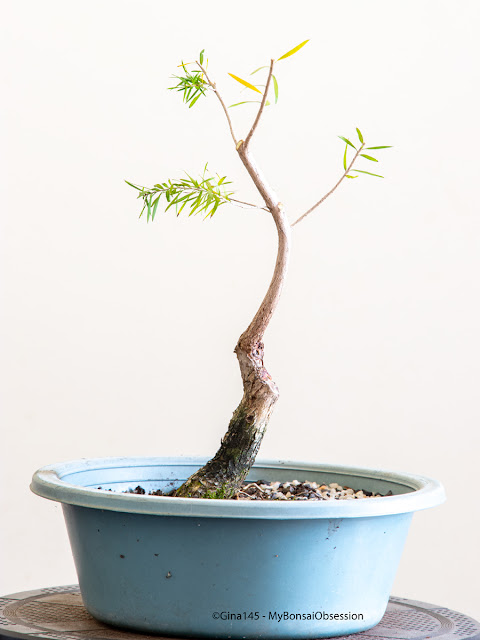
It was a long time since its previous chop as I waited for the leader to reach a suitable thickness. This is how long the leader was before its latest chop earlier this week.
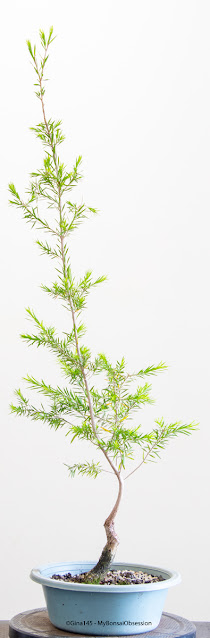

It's come a long way since I nearly killed it almost four years ago.

Now I'll wait and see what grows lower down. If a suitable leader develops I may till shorten it further. Or perhaps I'll just keep its current quirky shape.

Progression photos, which will include future updates and hopefully photos to fill the three year gap, can be found here.

Tuesday, 19 May 2020

Is my Ficus Fusion Project Dying?

The tree as it looks today (front view)

Everything was going so well with the Fusion Project which I've been developing from a bunch of Ficus Natalensis cuttings over the last four and a half years.

I was finally happy with the way the trunk was fusing and had started some styling work.

In the period up to January 2020 I took it to a couple of meetings looking for advice.

January 2020 - before pruning

A few people felt that the first branch (the thick one, above the cutting I've planted to try to widen the trunk) should be removed, but I didn't like that idea and chose to shorten it instead. I also felt the tree was getting rather top heavy, so I cut it back to a new leader.

January 2020 - after pruning

For a while everything seemed fine but the first signs of trouble appeared sometime in March, shortly before lockdown. I have a photo showing serious die-back which was taken on 27 March. That was the day I decided to remove the dead leaves, but leave the branches intact in case some of them survived.

At the time I thought that a badly executed cut had killed the top and I wasn't too concerned about it as the tree was taller than I wanted it to be anyway. I was unaware of any further problems after that.

A couple of weeks ago, when the first signs of winter appeared, I moved the tree into my greenhouse.

Then this morning, I noticed a whole new section of dying leaves.

Best case scenario here is that I'm going to have a much shorter tree than I'd planned. To be honest I'd be quite happy with that.

But right now I'm terrified that this is just the beginning of the problem and that the tree is dying. And right now, with the Covid-19 pandemic in full swing, I'm unable to take the tree anywhere to ask for advice.

If anyone reading this can offer me some assistance, it will be most welcome. I've put a lot of effort into creating this tree and I'd hate to lose it.

The tree as it looks today (back view)


Monday, 18 May 2020

There's a tree hiding inside that mess

When I visit my various online bonsai groups lately I see everyone's trees getting tons of love during lockdown. Sadly mine aren't among them.

For me the social side of belonging to a bonsai club has always been almost as important as the trees themselves, and now that club meetings have been removed from my life for the foreseeable future, I'm struggling for motivation. So much so that, aside from watering my trees and providing winter protection where necessary, I've done very little work on them over the last few weeks. It's much easier to go online and read about other people's trees.

That's not okay though. It's time to get back to work.

I finally made an attempt with my Ficus Salicaria (willow leaf Ficus).

More weeds than tree - May 2020

Poor little thing has been seriously neglected. Can you even see that there's an almost decent tree hiding inside that mess?

After a little time spent pulling weeds, here it is.


Sadly it hasn't changed very much since I last wrote about it in August 2018. That's what happens when you have too many trees and don't give them the attention they deserve!

It needs a proper pruning, but first I'm planning to give it a little time to recover from the shock of my digging around in the soil. That disturbance isn't ideal as we're headed into winter, but it had to be done.

I also need a little time to think about my next move.

I'm pretty sure I'll be bringing the height down though - probably to the thickest branch growing upwards on the left side of the tree. Maybe in time I'll go even lower because I like my trees short and fat.

But for now there's a lot of other work to be done. I've got many trees with similar weeds that need to be removed.

Sunday, 12 April 2020

Ficus Pumila Bonsai Failure

I was really proud when I created a mame bonsai from a Ficus Pumila cutting a few years ago. So much so that I even put it on show once. At the time it looked something like this:

November 2015 (with apple to show the size)

Growth was a little sparse, but I hoped for improvement in the years to come.

Unfortunately it's been all downhill since then. By April 2018 the leader had died and it had deteriorated to this:

April 2018 - after some damaged branches had been removed

With too many trees to care for I never got around to trying any of the options I referred to in my April 2018 update.

Instead it's largely been left to do its only thing. When I checked up on it a few days ago, it was seriously overgrown, with long branches which had rooted themselves into the pots of the Bougainvillea and succulent standing beside it.


After separation the Bougainvillea has two new Ficus Pumila plants growing in its pot.


The one of the right has grown up the trunk of the Bougainvillea and the two appear to have fused together.

As it's autumn in South Africa I don't want to do any repotting now, so I'll have to sort this mess out in spring.

And then there's the overgrown Ficus Pumila (no longer worthy of the name bonsai).


After shortening the long branches, a problem becomes visible.


The extent of the problem is much more obvious from the back.


The twisty trunk I worked so hard to create is dead. All the growth is coming from the first inch of the trunk.

Again I'll wait until spring before making any final decisions, but I think that this is a lost cause as bonsai. I'll probably give the plant away and keep the pot.

I still have to work out whether I can do anything with the two larger Ficus Pumila plants that appeared in the April 2018 update.

Fortunately the tiny Ficus Burtt-Davyi that appeared in that post is showing a lot more promise.

Friday, 10 April 2020

Mango Tree - an Update

In August 2017 I wrote a post about unsuitable material for bonsai. Most of the trees I discussed in that post were trees I'd grown from seed, in some cases hoping to turn them into bonsai. As I said at the time, however, I had no delusions that I could ever bonsai a mango tree, but I couldn't resist the temptation to grow my own mangoes.

By the time I wrote that post my mango tree was seven years old and was flowering for the first time.

Mango flower buds - August 2017 

I was thrilled, but also a little bit disappointed when I read that it was best for the health of the tree to remove the first season's flowers. I really didn't want to do it.

In the end the decision was taken out of my hands as a really heavy hail storm did the job for me.

My tree grew very little for the rest of that summer and in spring of 2018 there wasn't a trace of a flower anywhere.

Finally in spring of 2019 it started flowering again so I moved it into my greenhouse - near the door, so that it had decent exposure to sun and wind, but was protected from hail.

It worked. Over the last few months it's had three green mangoes dangling from its branches.

I'd pretty much given up hope of them ripening though as the stems they were dangling from looked like they were dying, but a couple of weeks ago they started turning orange.

Tree with 3 mangoes - April 2020

I'm not convinced they'll be edible, but when they look ready I'm planning to cut them open just in case.

Update: The day after I published this post one of the smaller mangoes fell off the tree. Although it was probably the smallest mango I've ever had, the inside was no worse than the mangoes I buy from stores. It tasted fine.

Perhaps the fruit would have grown better in a bigger pot. If I can find a suitable pot at home, maybe I'll slip it into a bigger pot once the rest of the fruit comes off.

Tuesday, 18 February 2020

A Huge Juniper Transformed

Last Saturday I decided to attend a meeting at Midway Bonsai Society after hearing that a young member of Eastern Bonsai Society (EBS)  - the club I've been a member of for 12 years - would be doing a demonstration on a huge juniper.

Shaundre Craukamp may only be 19, but he already has a lot of bonsai experience, having joined his first club at the age of 10. After that club closed, he moved to EBS when he was 14. A year later he won the EBS and regional new talent competitions. Later that year he went on to win the national competition, becoming the youngest South African to do so.

The trees used for those competitions were nursery stock- Juniper Procumbens Nana, a little smaller than the one he's seen working on in an earlier post (he's the guy in black). Unlike the one in that post, however, competition trees have had no previous styling.

The tree he worked on this time was a collected tree - Juniper Chinensis - belonging to Jonathan Cain, a member of Midway.


Shaundre started by doing a little carving on some of the dead wood at the bottom. (There was far too much to be done in one session.)


He chose to do the carving by hand.


Then he moved on to the apex.


As everything up there was long and straight, and growing away from the trunk, a lot of bending was required - too much to be done at once without putting excessive strain on the tree, but enough to show the direction in which the tree will be developed.

First he split the area he wanted to bend, then he applied tape to prevent the branch breaking when he bent it.


After wiring the branch and adding some guy wires, he was able to pull it down in the direction he wants it to grow. I believe it will be brought closer to the trunk when it's had time to heal.


This was already a big improvement, but the branch coming up from the bend looked out of place, so he removed it, leaving a stub which will be used as a jin.


He then bent one of the lower branches up to create a new apex.


He marked a few areas that will need carving, including the marked branch, which is currently far too long and thick.


After all the small branches had been wired (with help from Jonathan and his wife Denise) and re-positioned the tree looked like this.


Shaundre will be paying Midway another visit next spring to do further work on this tree.

Sunday, 8 December 2019

Hard Pruning a Schefflera

When someone at a bonsai workshop advises me to chop trees back to leafless stumps, I'm often reluctant to do it. Although I've had some success with trunk chops, most of the time I'd rather cut trees back to the lowest growth, wait for back budding, then cut back further. Progress is a little slower that way, but I prefer to err on the side of caution.

With some species that approach doesn't work though. When I prune Scheffleras they tend to grow back from the point at which they were cut, not lower down where I want new branches.

So when I decided that this little Schefflera needed pruning, drastic measures were called for.

November 2019 -  before pruning

Some of the newer members of my club were horrified when I told them my plans, but I knew what had to be done. A few quick cuts later I was left with this.

November 2019 - after pruning

Scheffleras are slow growers and now, four weeks later, there are only a few tiny buds starting to put in an appearance on the branches. I know that my little tree is doing okay, but looking at it still makes me nervous.

At the time it was chopped I discussed my plans for its after-care with another member of my club. I said I intended to return it to its home in my greenhouse. He felt it should go outside.

At the time his idea seemed a viable option as the weather was extremely dry, so I felt a bit foolish when I said I wanted to protect it from the possibility of excess rain. But I feel vindicated now because it's been raining almost continuously for nearly five days. Slow persistent rain which is showing no sign of abating. Grey skies have become the norm and I've almost forgotten what the sun looks like! That's not normal weather where I live, but it happens every now and then.

I've seen what damage that kind of weather can do to a tree in this state.

Years ago I defoliated a similar Schefflera. That was back in the days when I still tried to grow some of my trees indoors. Keeping it inside shouldn't have been a problem. Scheffleras are very tolerant.  I kept my big one in a very dark room for years before I realised the error of my ways and moved it outside. My problem was that I lost patience. When it was progressing too slowly on a sunny windowsill, I decided to move it outside.

As luck would have it, a few days later we were hit by the kind of weather we're experiencing now. Too much water for a tree without leaves! In a few days it was dead.

Had I left this one exposed to the elements, it would probably have died too.


Monday, 22 April 2019

This Little Juniper Survived

Some sloppy wiring a year ago reduced my healthy little Juniper Procumbens Nana to half a tree.

August 2018

Thankfully eight months later it has made a good recovery.

April 2019 - too straight

It was still looking very straight and ugly though, so yesterday I decided to make another attempt at styling it.

I struggle with thick wire, especially on little trees,so I decided I wasn't going to risk that again. I don't want to kill what's left of the tree!

After an unsuccessful attempt to put some movement into the tree using thin wire doubled up, I decided to try something different. Instead of using a guy wire, however, I pulled the apex to the right and slightly forward using a humble cable tie - a trick I picked up at last Saturday's club meeting.

April 2019 - not so straight any more

Much better!

Unfortunately even the minimal wiring I attempted caused a little damage to the bark.

Damaged bark at base and a new bud a little higher up

Hopefully it's not bad enough to do any long term damage.

I'll probably wait another year before I prune it. If I'm lucky some of the new buds on the trunk with grow and give me a couple of extra branches to work with.


Monday, 18 March 2019

Positive Results from a Trunk Chop

When I did my most recent air layer on a member of my Ficus Ingens family, I was hoping it would stimulate new growth lower down the trunk. As long as the air layer was attached to the parent tree, however, that never happened.

That's why, despite knowing that Ficus Ingens are tough trees, when I separated them in February I was a bit concerned about the survival of the parent tree which had been reduced to a bare stump. I ended my previous post posing the question :
"After it's stubborn refusal to produce any low branches, will this finally shock it into cooperating, or will it kill the tree?"
 Happily it did the former. The stump is alive and well, with lots of new branches all along the trunk:


In fact in several places the growth pattern of this species led to multiple branches sprouting from one spot.


I had to thin those out or they would have caused ugly bulges on the trunk as they thickened.


After a quick tidy up, the tree looks like this:


There are new buds sprouting near the top of the tree, so I should be able to keep it to its current height - if I choose to do so.

The lowest branch is still there. As the second photo was taken from the opposite side, it's hiding behind the trunk. I'm not making any styling decisions now, but once I see how the tree develops I may remove that branch.

A full progression as well as future updates for this tree can be found here.

The new tree I propagated from the top is doing well too.


It has a couple of new branches along the straight part of the trunk and there are already a few roots growing out of holes in the pond basket.


Pretty good for six weeks' growth!


Saturday, 9 March 2019

How to Kill a Juniper

Browsing through the Reddit bonsai group there are always a lot of posts from newbies with their first tree, and that tree is often a Juniper. Sadly many are led to believe that it's okay to keep their Juniper indoors. The truth is that's the easiest way to kill it. The bad news is that Junipers stay green for months while they're dying, and by the time the owner realises their tree is sick, it's usually already long dead.

I was lucky. I've never made that particular mistake. But that's not to say I've never killed a Juniper.

I've already written a few posts about the Juniper Mint Julep I bought as a candidate for Reddit's nursery stock contest in March 2018.

As purchased - March 2018

Having seen many people on Reddit advising first time Juniper growers not to do too much work at once, I tried to be gentle with my tree and though I removed a lot of the top, I left a couple of unwanted low branches to avoid shocking the tree too much.

April 2018

It made it through the Southern hemisphere winter without any trouble.

My big mistake was taking it to a club meeting in September 2018. I didn't even plan for it to go on the table for critique, just to enquire from an expert whether it was safe to remove those low branches. Unfortunately some of the members had other ideas, and I came home with this:

September 2018

I was really disappointed with this new styling and felt it was no longer "my" tree. And I was extremely concerned about its survival. The suggestion that I repot it immediately sounded like a bad idea, and I decided against it.

Perhaps at that stage it still stood a chance of surviving, though it would have been a long time before it grew branches that I would  have been happy to work with. Unfortunately, when discussing the tree with another experienced grower a few weeks later, I was told it was okay to repot it, so I did. The root pruning involved was the last straw, and by December 2018 it had lost all its foliage, though I found signs of hope in the form of one tiny green bud growing from the section that was intended to be used as dead wood.

Signs of hope - December 2018

And my hopes were finally dashed when that bud died a few weeks ago.

If I ever buy another Juniper (unlikely), I'll definitely take my advice from Reddit and stick to the principle of one insult per season. Perhaps they can survive more, but there are bound to be problems along the way.

That was certainly the case with a Juniper I worked on when I attended a beginner's course back in 2007. The tree was pruned, wired and planted in a bonsai pot, all over the period of two days. It survived, but the top died and a makeover was required within months. It's been restyled a few times since then, but to this day I'm not happy with that tree and I'm determined to find it a new home one day. If I can get a little money for it, I'll probably spend it on another ficus!

Tuesday, 5 March 2019

The Second Ficus

Yesterday's post was all about the first of my two neglected ficuses, a tree which had benefited greatly from the development of a vigorous and totally unplanned sacrifice branch.

At the time I had not yet done anything to its sibling aside from removing a few dead branches. I've just finished working on that one - it received much harsher treatment than yesterday's tree because the trunk was long and straight with very little taper.

Ficus Natalensis - March 2019

I started by removing the top section, which left potential for something approximating a formal upright tree:


I contemplated stopping there. However I'm trying to focus on short fat trees rather than tall skinny ones, so I knew I wouldn't be happy with that in the long term.

In the end I stuck to my original plan and cut to the lowest branch, leaving what is currently a very ugly tree.

March 2019 - after the chop

No point in wiring that branch because I don't plan to use it as a leader. It's just a sacrifice branch which will be removed along with approximately half the trunk once I get growth where I really want it.

Both trees - March 2019

I can't wait to see what these trees look like a year from now.


Monday, 4 March 2019

The Benefit of Neglect

I hate to admit that the last time I worked on my two neglected ficuses was when I repotted them in November 2015. Because of time constraints only one ever made it into my previous blog post and once again that's the only one I've had time to work on so far. Coincidentally, for the moment it's the better tree.

In November 2015 that tree looked like this:

Ficus Natalensis - November 2015

A few sharp bends and hardly any taper!

Although my neglect means that the trees are no closer to being bonsai than they were three years ago, the move to bigger pots has allowed them to grow big and tall and their trunks have fattened up considerably. Unfortunately the top growth has blocked light from the lower part of the trees and as a result, both have lost some lower branches. The tree above also developed a massive low branch which grew upwards, reaching a height  twice that of the intended apex.

Same tree - March 2019

Under the circumstances I found myself having to treat it as nursery stock when I took it to a workshop on Saturday afternoon.

First I had to get both trees out of the greenhouse though, and that proved to be quite a mission as once again one had sent a root into the other one's pot and both had also sent roots through the slats of the shelf they were living on. To complicated matters further, the neighbouring orchid (a gift which I tend to ignore) had sent roots into both pots. That meant there were quite a lot of roots that had to be cut before I could move the trees.

Once at the workshop the first step was to remove that huge branch.

After removing the huge branch

The tree was already looking better but it was rather top heavy, with a leader growing in the wrong direction. The club member I was working with recommended I cut back to a new leader, advice I was happy to follow, as I'd already said in 2015 that "At a later stage I might reduce the height further".

March 2019 - after pruning

As it's still in the same pot, the change in the thickness of the trunk is pretty obvious.

I've left all the aerial roots for now as we're headed into winter. I'll decide whether to keep any of them when I repot the tree in spring - as long as I don't forget!!

As for the second tree, it looked like this when I removed it from the greenhouse:

Second tree - March 2019

I've removed a few dead branches so far and plan to cut it back to the lowest living branch, then wait for back budding before cutting in to a more suitable height. I'd like to make a short, fat little tree from this one.