Showing posts with label fusing. Show all posts

Tuesday, 19 May 2020

Is my Ficus Fusion Project Dying?

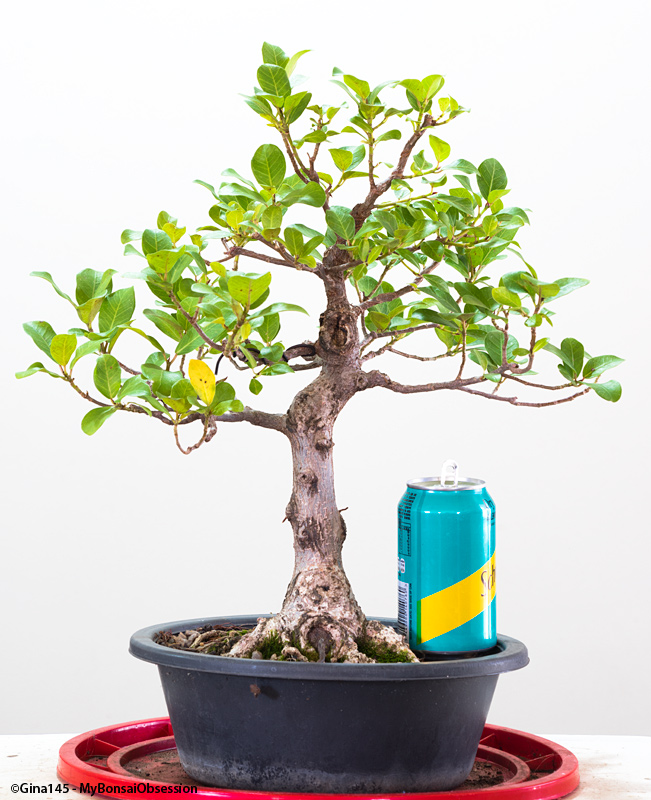
The tree as it looks today (front view)

Everything was going so well with the Fusion Project which I've been developing from a bunch of Ficus Natalensis cuttings over the last four and a half years.

I was finally happy with the way the trunk was fusing and had started some styling work.

In the period up to January 2020 I took it to a couple of meetings looking for advice.

January 2020 - before pruning

A few people felt that the first branch (the thick one, above the cutting I've planted to try to widen the trunk) should be removed, but I didn't like that idea and chose to shorten it instead. I also felt the tree was getting rather top heavy, so I cut it back to a new leader.

January 2020 - after pruning

For a while everything seemed fine but the first signs of trouble appeared sometime in March, shortly before lockdown. I have a photo showing serious die-back which was taken on 27 March. That was the day I decided to remove the dead leaves, but leave the branches intact in case some of them survived.

At the time I thought that a badly executed cut had killed the top and I wasn't too concerned about it as the tree was taller than I wanted it to be anyway. I was unaware of any further problems after that.

A couple of weeks ago, when the first signs of winter appeared, I moved the tree into my greenhouse.

Then this morning, I noticed a whole new section of dying leaves.

Best case scenario here is that I'm going to have a much shorter tree than I'd planned. To be honest I'd be quite happy with that.

But right now I'm terrified that this is just the beginning of the problem and that the tree is dying. And right now, with the Covid-19 pandemic in full swing, I'm unable to take the tree anywhere to ask for advice.

If anyone reading this can offer me some assistance, it will be most welcome. I've put a lot of effort into creating this tree and I'd hate to lose it.

The tree as it looks today (back view)


Monday, 14 May 2018

Growing Big Trees from Small Cuttings

A member of Reddit's bonsai group recently asked me this question:

"What's the thickest you've ever got a tiny cutting up to? Guess I'm wondering what 10 years can do!"

The simple answer is that I made the decision early on  to restrict myself to trees and pots that I'm able to carry unassisted. As a small woman, that limits my ability to grow big trees. Still, some of them have reached a decent size over the years and if it hadn't been for some beginner's mistakes, they would have done even better.

Let's start at the beginning.


May 2018

My first Ficus Natalensis cutting serves as a good lesson in how NOT to grow a decent trunk. Yet I was once proud enough of this tree to publish an article about its early development at HubPages. That was long before I ever dreamed of starting my own blog.

I guess it works if you're new to bonsai and you're happy to grow a skinny little tree. Provided you're working with a fast growing species, that is!

After several years in a bonsai pot, this tree has been back in a training pot for over two years now but it's not making as much progress as I'd like. It doesn't help that I rarely think to rotate my trees. The back of this one was close to a wall and it now has quite a bit of die back on the lowest branches. I'll have to work on fixing that next summer.

Measurements:
9cm across the usable nebari (some roots are badly in need of pruning)
5cm just above the roots
Height 34 cm

Sometimes I'm tempted to give this one a total revamp, though probably not what I suggested a few months back. But when I think about it, I tell myself that I should stick to its original styling as a reminder of how I got started in bonsai.

This one is slightly more impressive.


May 2018

I'm guessing that it's approximately 9 years old, though I haven't had a chance to check all my old photos.

Most of the trunk growth occurred quite early in its life, before I made some styling choices I've come to regret. How I wish I'd never removed the lower branches. But what's done is done.

Measurements:
13cm across the nebari
6cm just above the roots
Height 41 cm

I'm seriously tempted to do an air layer here as I think there's good potential for a smaller tree using the top and I can make a short fat one with the bottom part.

The next one has mostly been allowed to grow unchecked.


May 2018

I'm not sure how old this one is, but it's younger than the other two.

Again I made one cut early on that I now regret. Other than that I've done little pruning, only shortening some branches from time to time. In my crowded bonsai area some of the lower branches haven't been getting enough light though and there's quite a bit of die back. That's not really an issue when it comes to styling because this tree has a trunk chop in its future - probably in the form of an air layer as early as next spring.

I recently discovered an aerial root at the bend which will make the trunk even more impressive when it fattens up.

Close view showing aerial root - May 2018

I'm not sure if I'll still be able to reposition it - I'll have to see about that when the air layer is done.

Measurements:
10-12cm across nebari - depending on final choice of front
6-7cm above roots - exclusing aerial root
Height 99cm

And then there's the easy way.


Fusion project detail - May 2018

If you don't want to wait years for a trunk to fatten up, fuse several cuttings to create one fat tree. My project is relatively small, but that's only because I couldn't cope with anything much bigger. If you've got lots of cuttings and can cope with big trees, the results can be really impressive.

Measurements:
6.5 cm across roots
Height 61cm

I'm sure this one could already have been quite a bit bigger if I hadn't left it in my greenhouse for two years. One summer outside has made a big difference.


Saturday, 24 February 2018

The Fusion Project

In August 2015 I decided to fuse some of my long, straight Ficus Natalensis cuttings together to create one larger tree.

In order to plant them close together a lot of root pruning was required. Some had fairly substantial roots, so I was able to keep a few of the thickest ones to grow as root cuttings. The two resulting trees are doing well, but I'll discuss those another time.

Once potted I bound the bases together with self-adhesive tape. I'm not sure why I didn't bind them higher up as well, but once done I had this as my starting point:

August 2015

The base looked like this:

August 2015 - detail

As the nights were still cold (August is the end of winter here) I put them back in my greenhouse and due to space constraints they remained there for the next couple of years.

By November 2016 they were growing strongly, but when I removed the tape they were showing no signs of fusing:

November 2016 - detail

I replaced the tape, adding more higher up on the trunk, but didn't think to add movement. Here they are in December 2016:

December 2016

Finally in May 2017 I realised my mistake and tried to wire some movement into them, but after wrapping thick wire around them I found I was unable to bend the wire as much as I wanted to, so I took them to a workshop where my mentor did the muscle work for me.

Wired - May 2017

And in spring 2017 I finally moved them out of the greenhouse into a sunnier spot.

When the wire started biting I removed it and got help in rewiring them to ensure the curves didn't bounce back to their original position. After the wire started biting a second time I decided it was no longer required. This photo was taken a few days ago, several weeks after the wire was removed.

February 2018

Close-up photos show good fusion in some places:

February 2018 - detail of lower trunk

However, in other parts there are still big gaps:

February 2018 - detail of upper trunk with gaps

I added extra tape to this area, so hopefully the gap will soon close.

February 2018 - gap taped

There are a couple of additional photos here. More photos will be added to that page as the tree develops.

Hopefully by next summer the trunk will have developed well enough for me to start thinking about branch selection.

Tuesday, 7 February 2017

Still Struggling with my Three-in-One Ficus

When I conceived my plan to fuse three different colour varieties of Ficus Benjamina about a decade ago I had no idea what complications this gimmicky project had in store for me.

While the trunks have fused well enough to confuse some people, differences in the growth habits of the three varieties have resulted in some branches growing more vigorously than others.

Working around that has been a constant battle, further complicated by the fact that I got carried away with what was meant to be minor pruning in late 2015. After that I made the mistake of letting the tree grow largely unchecked for over a year.

February 2017 - before styling

Had the dark-leaved branches (the most vigorous) been near the bottom of the tree, that might have worked out alright. Unfortunately all those branches were high up and as a result they had become disproportionately thick and had also created some nasty reverse taper and a massive bulge high up on the trunk.

Although it's another setback in the tree's progress I decided those branches had to go.

The old leader was contributing to the problem too so, with a better option having presented itself, I removed that as well. I also decided that the lowest branch didn't fit in with my future plans for the design of the tree.

Here it is after another major pruning and some wiring.

February 2017 - after styling

Right now the new leader needs to fatten up a bit, but hopefully I'll pay enough attention to keep the vigorous top growth under control this time.

And hopefully today's work will stimulate some back-budding because the tree really needs a couple of extra branches on the right side to get things properly balanced.

Sunday, 14 August 2016

Torturing Trees

I've been a night owl my whole life and as a result I've never been a fan of morning workshops. However I need the input of more experienced growers, so I usually attend those workshops nonetheless.

Unfortunately when winter comes around I find it really difficult to drag myself out into the cold morning air and this year I've been particularly lazy, missing several consecutive workshops and generally not giving my trees the attention they deserve. Now however, with spring definitely in the air, I decided it was time to get back to work, so I headed off to today's workshop, taking along a couple of my more complicated repotting jobs just in case I lacked the physical strength to get the work done on my own.

While working on my own trees, I also got to observe what others were doing to theirs. That can be quite an education.

Among today's attendees was a man who was working on a ficus with two trunks growing close to each other. As he didn't feel they'd make an appealing twin trunk bonsai, he decided the best option was to fuse them into one thicker trunk. Tying them together without leaving gaps was no easy task as each was already quite thick. Part way through his work I was greeted by this frightening sight:


A few strategically places clamps had been used to hold the trunks tightly together until they could be securely tied in place. Once that was done, the clamps were removed and a bit of wiring was done.


I guess now it's up to the tree to do its part.

In between all the serious work done today there was also some light relief as the youngest member of our club decided to "attack" a little tree with a massive pruning tool he found lying in the garden.


Sunday, 20 September 2015

Three Trees Become One

At a recent meeting of my bonsai club one of our senior members spoke about grafting, discussing a variety of different ways in which it could be used to improve our trees.

Although I've seen several of these methods used at workshops in the past, traditional grafting isn't something I've tried doing myself and to be honest I'd probably need a man's help if I chose to try some of the things he demonstrated.

Among the methods he showed us was how fusing several trees together can help to create fat trunks quickly. I used that method to create the tree being discussed here, although my reason for doing so was slightly different.

Tree created by fusing three different varieties of Ficus Benjamina

Many years ago, before I ever joined the club, I dreamed about creating a ficus bonsai with three different colours of foliage - different colour leaves on different branches. I'd seen braided ficus trees for sale on many occasions so that seemed like the obvious way to go. I didn't realise at the time that braiding is not the recommended method of fusing trunks as it can give a rather knobbly effect which never really goes away. You can see that effect in this photo of a tree which  was already braided when I bought it.

Knobbly effect of plaited trunks on a nursery bought tree

Fortunately I started my tree with very young material though, so the effect of the braiding is not so obvious. I used three very thin cuttings from different varieties of Ficus Benjamina and braided the cuttings tightly as soon as they had formed adequate roots to support them.

As Ficus Benjamina is a fast growing species, my tree quickly reached what I regarded as a decent height so that I no longer had to worry about braiding but could focus my attention on branch development. I was spoilt for options and had to remove a few branches to prevent the tree from looking too bushy. There are still visible scars where the branches were cut off, but in time they will become less obvious.

With hindsight I made a couple of mistakes. The first was in my choice of material for the palest leaves. I had two different varieties to choose from and sadly I chose the less vigorous one. The result is that those branches will never be as vigorous as the branches with darker leaves. I'm trying to fatten them up, but I'm not sure I'll ever succeed in getting the balance right.

My second mistake is more a change of artistic vision. I don't find the middle (yellowish) leaf shade so appealing and wish I'd restricted myself to using only the other two colours. I've often contemplated starting a new tree using just those two and hope to do so this summer.