Showing posts with label trunk chop. Show all posts

Sunday, 8 December 2019

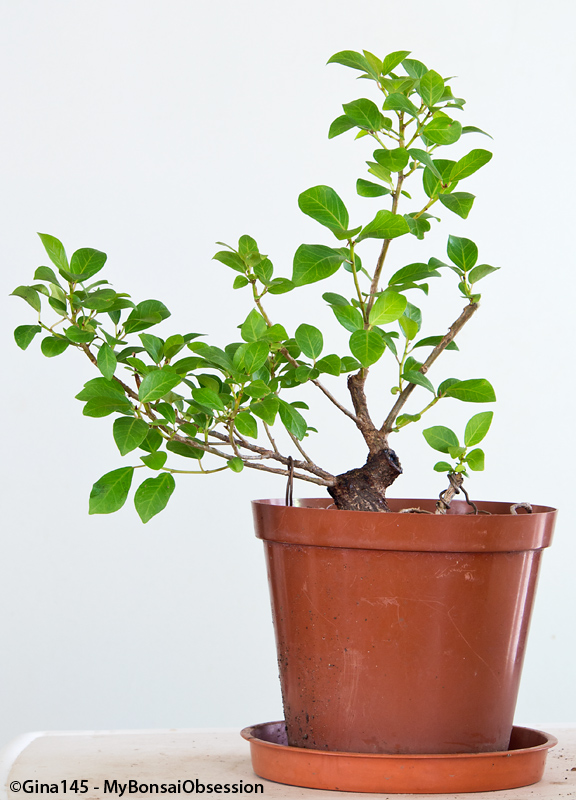
Hard Pruning a Schefflera

When someone at a bonsai workshop advises me to chop trees back to leafless stumps, I'm often reluctant to do it. Although I've had some success with trunk chops, most of the time I'd rather cut trees back to the lowest growth, wait for back budding, then cut back further. Progress is a little slower that way, but I prefer to err on the side of caution.

With some species that approach doesn't work though. When I prune Scheffleras they tend to grow back from the point at which they were cut, not lower down where I want new branches.

So when I decided that this little Schefflera needed pruning, drastic measures were called for.

November 2019 -  before pruning

Some of the newer members of my club were horrified when I told them my plans, but I knew what had to be done. A few quick cuts later I was left with this.

November 2019 - after pruning

Scheffleras are slow growers and now, four weeks later, there are only a few tiny buds starting to put in an appearance on the branches. I know that my little tree is doing okay, but looking at it still makes me nervous.

At the time it was chopped I discussed my plans for its after-care with another member of my club. I said I intended to return it to its home in my greenhouse. He felt it should go outside.

At the time his idea seemed a viable option as the weather was extremely dry, so I felt a bit foolish when I said I wanted to protect it from the possibility of excess rain. But I feel vindicated now because it's been raining almost continuously for nearly five days. Slow persistent rain which is showing no sign of abating. Grey skies have become the norm and I've almost forgotten what the sun looks like! That's not normal weather where I live, but it happens every now and then.

I've seen what damage that kind of weather can do to a tree in this state.

Years ago I defoliated a similar Schefflera. That was back in the days when I still tried to grow some of my trees indoors. Keeping it inside shouldn't have been a problem. Scheffleras are very tolerant.  I kept my big one in a very dark room for years before I realised the error of my ways and moved it outside. My problem was that I lost patience. When it was progressing too slowly on a sunny windowsill, I decided to move it outside.

As luck would have it, a few days later we were hit by the kind of weather we're experiencing now. Too much water for a tree without leaves! In a few days it was dead.

Had I left this one exposed to the elements, it would probably have died too.


Monday, 18 March 2019

Positive Results from a Trunk Chop

When I did my most recent air layer on a member of my Ficus Ingens family, I was hoping it would stimulate new growth lower down the trunk. As long as the air layer was attached to the parent tree, however, that never happened.

That's why, despite knowing that Ficus Ingens are tough trees, when I separated them in February I was a bit concerned about the survival of the parent tree which had been reduced to a bare stump. I ended my previous post posing the question :
"After it's stubborn refusal to produce any low branches, will this finally shock it into cooperating, or will it kill the tree?"
 Happily it did the former. The stump is alive and well, with lots of new branches all along the trunk:


In fact in several places the growth pattern of this species led to multiple branches sprouting from one spot.


I had to thin those out or they would have caused ugly bulges on the trunk as they thickened.


After a quick tidy up, the tree looks like this:


There are new buds sprouting near the top of the tree, so I should be able to keep it to its current height - if I choose to do so.

The lowest branch is still there. As the second photo was taken from the opposite side, it's hiding behind the trunk. I'm not making any styling decisions now, but once I see how the tree develops I may remove that branch.

A full progression as well as future updates for this tree can be found here.

The new tree I propagated from the top is doing well too.


It has a couple of new branches along the straight part of the trunk and there are already a few roots growing out of holes in the pond basket.


Pretty good for six weeks' growth!


Tuesday, 5 March 2019

The Second Ficus

Yesterday's post was all about the first of my two neglected ficuses, a tree which had benefited greatly from the development of a vigorous and totally unplanned sacrifice branch.

At the time I had not yet done anything to its sibling aside from removing a few dead branches. I've just finished working on that one - it received much harsher treatment than yesterday's tree because the trunk was long and straight with very little taper.

Ficus Natalensis - March 2019

I started by removing the top section, which left potential for something approximating a formal upright tree:


I contemplated stopping there. However I'm trying to focus on short fat trees rather than tall skinny ones, so I knew I wouldn't be happy with that in the long term.

In the end I stuck to my original plan and cut to the lowest branch, leaving what is currently a very ugly tree.

March 2019 - after the chop

No point in wiring that branch because I don't plan to use it as a leader. It's just a sacrifice branch which will be removed along with approximately half the trunk once I get growth where I really want it.

Both trees - March 2019

I can't wait to see what these trees look like a year from now.


Tuesday, 16 October 2018

Starting a Large Portulacaria Bonsai from Nursery Stock

I never meant to buy anything.

When I stopped at the nursery about 10 days ago, I was just trying to burn a little time before meeting a friend at a nearby restaurant. I'm supposed to be cutting down on the number of trees in my collection, not adding more.

Everything started off well. The trident maples had decent bases, but they were about 10 feet tall with no low branches, so they were easy to ignore. And the small Portulacarias weren't the least bit tempting. I've already got a few and I tend to neglect them. So much so that I nearly lost one to root rot last year. I've reached the stage where I try not to buy anything unless it's a little bit special, like the variegated Portulacaria I bought in July.

But when I passed the big Portulacarias in another section of the nursery, everything changed. I'm not aware of ever seeing them that size before - well not unless they were growing in the ground anyway. Even so I nearly passed them by because the bags of soil they were planted in were so big that I felt sure I wouldn't be able to lift them. But I tried lifting one and was surprised to find that it was a lot lighter than it looked.

I couldn't buy it though. Not that day. I couldn't leave it standing in the car, visible for all the world to see, while I was at the restaurant.

It was three days before I was able to return. Luckily my chosen plant was still there because the others had much thinner trunks. Well all except one, and it turned out that I couldn't lift that one.

And so I came home with this huge plant which, in its bag, reached to just below my chin.

October 2018 - as purchased

I couldn't even contemplate putting it into a training pot until I'd removed all the excess growth.

October 2018 - after first rough pruning

At this stage all the branches on the left were in a straight line and I knew most of them would have to go, but I decided to leave my final selection until the tree was in a pot, planted at the correct height. A wise decision because, by the time the highest roots were exposed, the tree appeared a couple of inches taller.

October 2018 - still waiting for its final cut

I didn't discover that until a few days later though. Given its size I decided to get some help with the root work at my club's meeting.

In addition to adding height to the tree, removing the top layer of soil also exposed a couple of branches with their own roots, giving me two extra (much smaller) plants for my money.

October 2018 - two branches with their own roots

Once the tree was safely potted, it was time for the final branch selection. I was happy to find that several club members agreed with my decision to reduce the height a little further. Once I'd cut back to my chosen leader, the right branch was perfectly positioned on the bend. After removing the handlebars and the low branch coming straight to the front, I was left with just two branches. For now.

October 2018 - after final pruning

Who knows what options may present themselves when new growth appears?

It's unfortunate that the higher branch is the thicker of the two, but hopefully if I let the thinner one grow and keep the thicker one short, it won't take too long to correct that fault.

One last photo, just to show the size of the tree:

October 2018 - soda can for size

In addition to the two branches with roots, I've kept a lot of cuttings. If they all root, I'll have a not-so-small forest of Portulacarias of various sizes growing in my bonsai area. Maybe in a year or so I'll be able to sell some of them and recover the cost of the parent tree.

Tuesday, 13 February 2018

The Consequences of Over-Aggressive Pruning

Although I've been known to do a trunk chop from time to time (with mixed results), when I chop my trees I often err on the side of caution, cutting back to the lowest branch and waiting for back-budding before cutting back further. It slows the progress, but it's a safeguard against disaster.

When my succulent cuttings didn't sell in October 2017, however, I decided to throw caution to the wind with them, leaving only minimal foliage on one of the thinner cuttings and none at all on the rest of them. On the advice of a senior member of my club I'd done a similar chop on another thick succulent a few years back and, though the tree's recovery was slow, the result was satisfactory. I had no reason to suspect that things would turn out differently this time.

Perhaps October (late spring) wasn't the best time of year for this operation. Perhaps I did something else wrong. I just know that where the two thicker trees were concerned, things did not go to plan.

The thinner trees quickly produced masses of new growth everywhere, with only minimal die-back, allowing me to remove excess new buds within weeks.

November 2017 - not much to do on this pair

The first pair didn't need much work, but the one below was getting quite top heavy so I cut it back hard. I also removed the dead branch on the left.

November 2017 - before
November 2017 - after

The thicker trees were a lot slower to respond. By November they were showing signs of die-back on important branches, with little new growth high up and lots of tiny new buds at the base.

November 2017 - little new growth with nothing high up
Detail of the base of the above tree
November 2017 - little high growth and dying branch at base. New buds at
base not shown.

Perhaps if I'd removed some of the lowest buds I'd have got better growth higher up. Then again the trees might have died and, though they weren't trees I really wanted, I didn't want to take that chance. I hate killing trees.

By early January the thinner trees were doing really well.

January 2018
January 2018

Unfortunately, while the new buds at the base were growing strongly, the trunks of the two thicker trees had continued to decline. By now the thick branch at the base of this tree had deteriorated so badly that it snapped off with no effort, leaving a rotting hole which I attempted to carve away.

January 2018 - hole where branch had snapped off, before carving.

I was beginning to suspect that the entire trunk would be lost and developments over the past month make it seem my fears are justified.

February 2018 - carved hole, one month later.

The other one isn't looking much better, though there's no rot, so part of the trunk may survive.

January 2018

As I'm trying to cut down on the number of trees in my collection, I put the two thicker trees on my club's raffle table last Saturday. While they'll never be the trees I'd hoped they would be, in time someone may be able to develop them into decent clump style trees.

As for the remaining trees, I'm contemplating putting those on the raffle table too. Given their better condition I may do it in April, when my club is hosting an all day meeting attended by members of the other clubs in the region.

Saturday, 23 December 2017

Trunk chops, when properly done, do work

My last post inspired a bit of discussion among my Reddit readers, some of whom were insistent that one can chop trees below buds. When I thought about it I realised that I'd expressed myself badly when I said that one can't. Provided you're working with a suitable species it's perfectly acceptable to chop a tree to a stump with no VISIBLE buds and have it produce new branches at or below the site of the chop. Unfortunately in the case I was referring to, I chopped way too low, leaving a stump of less than an inch in height and, it would appear, no potential for new buds to form. However I've done several successful trunk chops since then.

An early one was my best trident maple, which gave me a bit of a scare back in 2009 but worked out well in the end. It was a five foot nursery tree when I bought it and, having a long drive in front of me, I asked the nursery staff to reduce the height so that it could fit into the car.

At the nursery, as purchased

This was how it left the nursery:

Autumn 2009, before workshop

I was still pretty new to bonsai at the time and wasn't sure how to proceed so I contacted my mentor who told me to bring it to a workshop. Although it was autumn, he repotted it and cut it back to a more appropriate height - or so we thought.

Autumn 2009, after workshop

Despite repeated efforts to seal the wound, it oozed sap for about two weeks, which was probably the cause of its problems in early spring. New growth was slow to appear and for a while I really feared for its life. And when new branches finally sprouted, they appeared about half way down the trunk:

Summer 2009

I had no choice but to cut the tree back to where there was new growth:

Summer 2009. after the second chop

With the benefit of hindsight the original chop would probably have left me with a tree that was far too tall and thin, so everything worked out for the best in the end. I'm quite happy with the tree's current state, apart from the nebari, but I'm working on that.

My most recent attempt at a trunk chop, done unassisted, involved two little elms I bought in late 2015. When I bought them they were growing together in one pot:

Two little elms as purchased, November 2015

Aside from feeling that they didn't belong together, I also felt they were too tall and straight, so I separated them and chopped both back to stumps.

After the chop, November 2015

Clearly this time I did everything right because they soon sprouted from their chop sites.

I've done very little work on them since then, only removing branches that I knew I'd never use and doing a little wiring where necessary.

This is how they look now:

Larger tree, December 2017
Smaller tree, December 2017

Right now I'm waiting for the leaders to thicken up a bit. Once that happens I'll reduce their height and start developing more branches. Hopefully in a couple of years from now I'll have the beginnings of two nice little trees.


Friday, 15 December 2017

How to Kill a Trident Maple

In October 2007 I bought a small Trident Maple at our club's annual show. I wasn't a member back then, but that was the day I signed up for the club's beginner's course and I attended my first meeting a month later. So you could say attending that show changed my life. It also changed my little tree's life, though certainly not for the better!

Although my Trident Maple was a nice little tree, I immediately set about redesigning it to make it truly mine. It would have been okay if I'd stopped after the first pruning, but worse was still to come for that tree.

One day I was browsing in the bonsai section of a local bookshop when I came across Peter Adams's book "Bonsai with Japanese Maples". I was tempted to buy the book but as I didn't own a Japanese Maple back then, I didn't see the point. (I did eventually buy it several years later.)

However, while looking at the book, I noticed a technique for growing fat trunks quickly. It involved cutting a tree back to a short stump, then letting all the new branches grow long and thick to fatten the trunk, cut them back and repeat... I couldn't resist the temptation to try it and the victim was my little Trident, the only Maple I owned at the time.

Unfortunately as a bonsai newbie I didn't realise that I needed to ensure that I left some buds below the chop site and I made the chop far lower than I should have. Then I waited impatiently for those new branches to grow, but sadly they never did.

The crazy part is that, even months later, I could see that my tree was still alive and with the benefit of hindsight I'm sure that it could have been saved if only a branch or two had been grafted onto it, but instead it was left to die a slow and painful death.

I now have several Japanese Maples, including three which I grew from thickish cuttings a few years ago, and I can't help feeling that this little tree (the ugliest of the three) would be a perfect candidate for that technique.

Japanese Maple grown from cutting.

The trouble is I've never had the courage to try again. I was tempted to try it this spring, but instead I've kept the height of the tree while trying to encourage the low branches to grow and keeping the top growth short.

I'll have to do something more drastic eventually, but it's the middle of summer now, so it's probably not the best time to do it.

Saturday, 21 October 2017

Taking My Succulents Back to Basics

So things didn't quite go as planned. Although I managed to  sell some trees at last weekend's show (my two best Junipers among them), none of my succulents sold. I think the lack of interest was due to the fact that they're so easy to propagate.

I briefly contemplated putting them on my club's raffle table next month, but I've decided not to give up that easily. Instead I cut them all back to a basic framework, leaving all but one totally devoid of foliage. One will need to be repotted at a different angle and the two in the last photo should probably be separated, but I'm not doing any of that right now.


before
after
before

after

before
after


before
after

It will be interesting to see what develops over the next 12 months. Maybe they'll be more desirable by then. Maybe a year from now I'll even want to keep some of them.

Sunday, 5 March 2017

Clip and Grow Ficus - the Third Chop and Beyond

This little Ficus Natalensis has far exceeded my expectations in terms of the progress it made this summer. When I wrote about its second chop back in September, I was expecting to let it grow unchecked for the rest of the season.

August 2016 - after the second chop

However when I saw how much it had grown by December 2016, I reconsidered my decision.

December 2016 - before pruning

While I knew that the new leader still needed to thicken more, I followed my mentor's advice and cut it back to the third branch to allow it and the two branches growing from it to develop in better proportion. As the leaves were looking rather ragged due to hail damage, I decided to defoliate the tree at the same time.

December 2016 - after pruning and defoliation

It soon filled out again.

February 2017 - before pruning

A few days ago when I brought it inside to get a  photo for this post,  I realised that the branch on the right was becoming too dominant so I shortened that one.

February 2017 - after pruning

And that I expect will be the last work I do on it for quite some time. Hopefully now the branches will thicken in better proportion.

The two bottom branches on the left will probably be removed at a later date as there is no branch to balance the composition on the right hand side. With the frame that is starting to develop higher up, I suspect that once the tree fattens up, it won't need branches so low down anyway.

The root cutting has finally decided it wants to become another tree.

February 2017 - base of trunk and root cutting

With winter approaching I've decided to leave it with its parent tree until early next summer, so the move to a larger pot will have to wait.