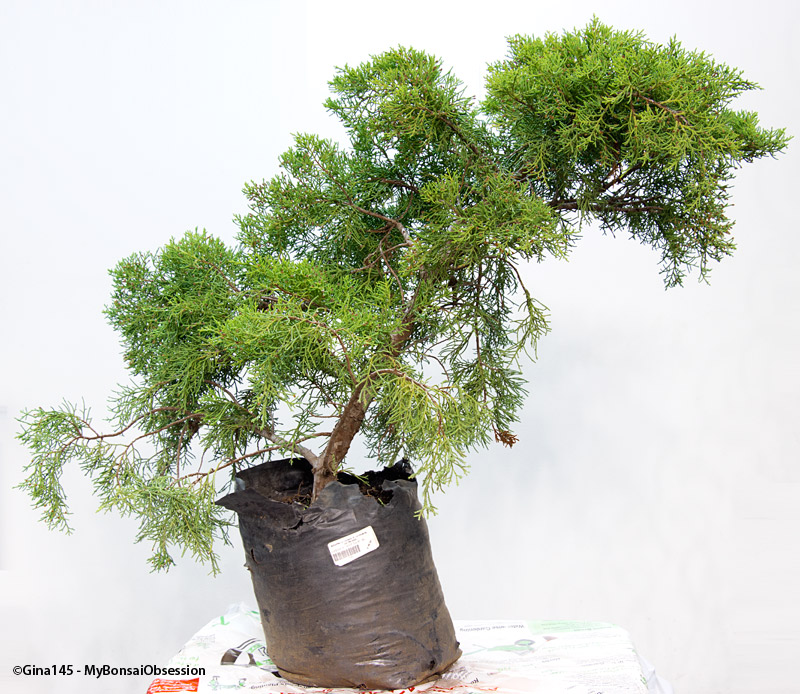
Last Saturday I decided to attend a meeting at Midway Bonsai Society after hearing that a young member of Eastern Bonsai Society (EBS) - the club I've been a member of for 12 years - would be doing a demonstration on a huge juniper.
Shaundre Craukamp may only be 19, but he already has a lot of bonsai experience, having joined his first club at the age of 10. After that club closed, he moved to EBS when he was 14. A year later he won the EBS and regional new talent competitions. Later that year he went on to win the national competition, becoming the youngest South African to do so.
The trees used for those competitions were nursery stock- Juniper Procumbens Nana, a little smaller than the one he's seen working on in an earlier post (he's the guy in black). Unlike the one in that post, however, competition trees have had no previous styling.
The tree he worked on this time was a collected tree - Juniper Chinensis - belonging to Jonathan Cain, a member of Midway.
Shaundre started by doing a little carving on some of the dead wood at the bottom. (There was far too much to be done in one session.)
He chose to do the carving by hand.
Then he moved on to the apex.
As everything up there was long and straight, and growing away from the trunk, a lot of bending was required - too much to be done at once without putting excessive strain on the tree, but enough to show the direction in which the tree will be developed.
First he split the area he wanted to bend, then he applied tape to prevent the branch breaking when he bent it.
After wiring the branch and adding some guy wires, he was able to pull it down in the direction he wants it to grow. I believe it will be brought closer to the trunk when it's had time to heal.
This was already a big improvement, but the branch coming up from the bend looked out of place, so he removed it, leaving a stub which will be used as a jin.
He then bent one of the lower branches up to create a new apex.
He marked a few areas that will need carving, including the marked branch, which is currently far too long and thick.
After all the small branches had been wired (with help from Jonathan and his wife Denise) and re-positioned the tree looked like this.
Shaundre will be paying Midway another visit next spring to do further work on this tree.
Showing posts with label Juniper. Show all posts
Tuesday, 18 February 2020
Monday, 22 April 2019
This Little Juniper Survived
Some sloppy wiring a year ago reduced my healthy little Juniper Procumbens Nana to half a tree.
Thankfully eight months later it has made a good recovery.
It was still looking very straight and ugly though, so yesterday I decided to make another attempt at styling it.
I struggle with thick wire, especially on little trees,so I decided I wasn't going to risk that again. I don't want to kill what's left of the tree!
After an unsuccessful attempt to put some movement into the tree using thin wire doubled up, I decided to try something different. Instead of using a guy wire, however, I pulled the apex to the right and slightly forward using a humble cable tie - a trick I picked up at last Saturday's club meeting.
Much better!
Unfortunately even the minimal wiring I attempted caused a little damage to the bark.
Hopefully it's not bad enough to do any long term damage.
I'll probably wait another year before I prune it. If I'm lucky some of the new buds on the trunk with grow and give me a couple of extra branches to work with.
![]() |
| August 2018 |
Thankfully eight months later it has made a good recovery.
![]() |
| April 2019 - too straight |
It was still looking very straight and ugly though, so yesterday I decided to make another attempt at styling it.
I struggle with thick wire, especially on little trees,so I decided I wasn't going to risk that again. I don't want to kill what's left of the tree!
After an unsuccessful attempt to put some movement into the tree using thin wire doubled up, I decided to try something different. Instead of using a guy wire, however, I pulled the apex to the right and slightly forward using a humble cable tie - a trick I picked up at last Saturday's club meeting.
![]() |
| April 2019 - not so straight any more |
Much better!
Unfortunately even the minimal wiring I attempted caused a little damage to the bark.
![]() |
| Damaged bark at base and a new bud a little higher up |
Hopefully it's not bad enough to do any long term damage.
I'll probably wait another year before I prune it. If I'm lucky some of the new buds on the trunk with grow and give me a couple of extra branches to work with.
Saturday, 9 March 2019
How to Kill a Juniper
Browsing through the Reddit bonsai group there are always a lot of posts from newbies with their first tree, and that tree is often a Juniper. Sadly many are led to believe that it's okay to keep their Juniper indoors. The truth is that's the easiest way to kill it. The bad news is that Junipers stay green for months while they're dying, and by the time the owner realises their tree is sick, it's usually already long dead.
I was lucky. I've never made that particular mistake. But that's not to say I've never killed a Juniper.
I've already written a few posts about the Juniper Mint Julep I bought as a candidate for Reddit's nursery stock contest in March 2018.
Having seen many people on Reddit advising first time Juniper growers not to do too much work at once, I tried to be gentle with my tree and though I removed a lot of the top, I left a couple of unwanted low branches to avoid shocking the tree too much.
It made it through the Southern hemisphere winter without any trouble.
My big mistake was taking it to a club meeting in September 2018. I didn't even plan for it to go on the table for critique, just to enquire from an expert whether it was safe to remove those low branches. Unfortunately some of the members had other ideas, and I came home with this:
I was really disappointed with this new styling and felt it was no longer "my" tree. And I was extremely concerned about its survival. The suggestion that I repot it immediately sounded like a bad idea, and I decided against it.
Perhaps at that stage it still stood a chance of surviving, though it would have been a long time before it grew branches that I would have been happy to work with. Unfortunately, when discussing the tree with another experienced grower a few weeks later, I was told it was okay to repot it, so I did. The root pruning involved was the last straw, and by December 2018 it had lost all its foliage, though I found signs of hope in the form of one tiny green bud growing from the section that was intended to be used as dead wood.
And my hopes were finally dashed when that bud died a few weeks ago.
If I ever buy another Juniper (unlikely), I'll definitely take my advice from Reddit and stick to the principle of one insult per season. Perhaps they can survive more, but there are bound to be problems along the way.
That was certainly the case with a Juniper I worked on when I attended a beginner's course back in 2007. The tree was pruned, wired and planted in a bonsai pot, all over the period of two days. It survived, but the top died and a makeover was required within months. It's been restyled a few times since then, but to this day I'm not happy with that tree and I'm determined to find it a new home one day. If I can get a little money for it, I'll probably spend it on another ficus!
I was lucky. I've never made that particular mistake. But that's not to say I've never killed a Juniper.
I've already written a few posts about the Juniper Mint Julep I bought as a candidate for Reddit's nursery stock contest in March 2018.
![]() |
| As purchased - March 2018 |
Having seen many people on Reddit advising first time Juniper growers not to do too much work at once, I tried to be gentle with my tree and though I removed a lot of the top, I left a couple of unwanted low branches to avoid shocking the tree too much.
![]() |
| April 2018 |
It made it through the Southern hemisphere winter without any trouble.
My big mistake was taking it to a club meeting in September 2018. I didn't even plan for it to go on the table for critique, just to enquire from an expert whether it was safe to remove those low branches. Unfortunately some of the members had other ideas, and I came home with this:
![]() |
| September 2018 |
I was really disappointed with this new styling and felt it was no longer "my" tree. And I was extremely concerned about its survival. The suggestion that I repot it immediately sounded like a bad idea, and I decided against it.
Perhaps at that stage it still stood a chance of surviving, though it would have been a long time before it grew branches that I would have been happy to work with. Unfortunately, when discussing the tree with another experienced grower a few weeks later, I was told it was okay to repot it, so I did. The root pruning involved was the last straw, and by December 2018 it had lost all its foliage, though I found signs of hope in the form of one tiny green bud growing from the section that was intended to be used as dead wood.
![]() |
| Signs of hope - December 2018 |
And my hopes were finally dashed when that bud died a few weeks ago.
If I ever buy another Juniper (unlikely), I'll definitely take my advice from Reddit and stick to the principle of one insult per season. Perhaps they can survive more, but there are bound to be problems along the way.
That was certainly the case with a Juniper I worked on when I attended a beginner's course back in 2007. The tree was pruned, wired and planted in a bonsai pot, all over the period of two days. It survived, but the top died and a makeover was required within months. It's been restyled a few times since then, but to this day I'm not happy with that tree and I'm determined to find it a new home one day. If I can get a little money for it, I'll probably spend it on another ficus!
Monday, 10 December 2018
Barely Alive
An update on the shrinking Juniper.
When I last wrote about this tree I was already concerned about its survival after the harsh treatment it had received over the previous few months. My once healthy nursery tree had been reduced from this:
to this:
and finally, at the hands of a member of my bonsai club, to this:
Despite my concerns, on the advice of two experts, I eventually decided to move it from its nursery bag into a training pot - a move which required a significant amount of root pruning.
It's gone steadily downhill since then and now has only a little browning foliage left on its one remaining branch. After removing the wire and bandage, it looks like this:
I have no doubt that many people would write it off as a lost cause at this stage, but right now it's still showing signs of life.
Strangely the most significant new growth is this small bud on an area I'd attempted to strip for future use as dead wood.
Obviously I didn't strip it very well!
I also discovered an even smaller bud lower down on the trunk.
If those buds actually develop into branches one day, it's likely to be years before I have anything to work with. But I'm amazed at this tree's will to live against all odds.
I hope it makes it.
When I last wrote about this tree I was already concerned about its survival after the harsh treatment it had received over the previous few months. My once healthy nursery tree had been reduced from this:
![]() |
| Juniper Mint Julep - March 2018, as purchased |
to this:
![]() |
| First styling attempt - April 2018 |
and finally, at the hands of a member of my bonsai club, to this:
![]() |
| Second styling attempt - September 2018 |
Despite my concerns, on the advice of two experts, I eventually decided to move it from its nursery bag into a training pot - a move which required a significant amount of root pruning.
It's gone steadily downhill since then and now has only a little browning foliage left on its one remaining branch. After removing the wire and bandage, it looks like this:
![]() |
| Barely alive - December 2018 |
I have no doubt that many people would write it off as a lost cause at this stage, but right now it's still showing signs of life.
Strangely the most significant new growth is this small bud on an area I'd attempted to strip for future use as dead wood.
![]() |
| New growth |
Obviously I didn't strip it very well!
I also discovered an even smaller bud lower down on the trunk.
If those buds actually develop into branches one day, it's likely to be years before I have anything to work with. But I'm amazed at this tree's will to live against all odds.
I hope it makes it.
Saturday, 8 September 2018
The Shrinking Juniper
One of the trees I bought in April as a candidate for Reddit's nursery stock contest was a rather large Juniper Mint Julep. I've already discussed its first styling in an earlier post.
As it was winter in South Africa, the tree has grown very little since then. I hadn't done any further work on it either - until today, when I decided to take it to my club's meeting for some "expert" advice.
I wasn't expecting to do much more than remove the unwanted branches that I'd left uncut in April for fear of removing too much in one go and killing the tree. But Junipers are outside my comfort zone so I was looking for confirmation that it was safe to cut them now. With the benefit of hindsight I'm starting to wonder if I'd have been better off if I'd stuck to my original plan and removed those branches at home.
Instead, when the tree went up for critique, everyone seemed to have different ideas, and people soon started bending branches into different positions. One member even shortened the leader (which I was trying to thicken) without asking if I was happy for him to do so.
By this time the tree was already looking quite different from its appearance in the above picture and I was no longer sure where I was headed, so when today's speaker asked if I wanted him to turn it into a dramatic tree, I agreed. On one condition - that he wouldn't kill my tree.
Before I knew it all the branches were gone and the leader was pulled downwards, leaving me with this:
Is there enough left to keep it alive? If it was a Ficus I'd say yes, but with a Juniper I'm not sure.
Plans for the future are a repot as well as carving and bending the jin. For now, however, my major concern is the tree's survival.
As it was winter in South Africa, the tree has grown very little since then. I hadn't done any further work on it either - until today, when I decided to take it to my club's meeting for some "expert" advice.
![]() |
| April 2018 |
I wasn't expecting to do much more than remove the unwanted branches that I'd left uncut in April for fear of removing too much in one go and killing the tree. But Junipers are outside my comfort zone so I was looking for confirmation that it was safe to cut them now. With the benefit of hindsight I'm starting to wonder if I'd have been better off if I'd stuck to my original plan and removed those branches at home.
Instead, when the tree went up for critique, everyone seemed to have different ideas, and people soon started bending branches into different positions. One member even shortened the leader (which I was trying to thicken) without asking if I was happy for him to do so.
By this time the tree was already looking quite different from its appearance in the above picture and I was no longer sure where I was headed, so when today's speaker asked if I wanted him to turn it into a dramatic tree, I agreed. On one condition - that he wouldn't kill my tree.
Before I knew it all the branches were gone and the leader was pulled downwards, leaving me with this:
![]() |
| September 2018 |
Is there enough left to keep it alive? If it was a Ficus I'd say yes, but with a Juniper I'm not sure.
Plans for the future are a repot as well as carving and bending the jin. For now, however, my major concern is the tree's survival.
Wednesday, 22 August 2018
My Juniper is Half Dead
The internet is full of stories of dead Juniper mallsai, many of them victims of the mistaken belief that they can be kept indoors. This is not one of those stories. I found a way to kill half my tree even though it was living outside.
Despite my reluctance to work with conifers, I currently have three Junipers in my collection - two small Juniper Procumbens Nana which I tend to neglect and a much larger Juniper Mint Julep which I foolishly bought as a candidate for Reddit's nursery stock competition though that tree was totally unsuitable for use as "instant" bonsai.
My younger Procumbens Nana is a tree which I propagated from a cutting when I entered my club's new talent competition a few years ago.
Until recently I'd never done any work on it at all. Then in April I saw a lovely little Juniper bonsai on Reddit. When I heard that it had been styled without wiring I was inspired to see if I could create a small Juniper bonsai the same way.
Unfortunately when I examined my tree I discovered that its structure was totally unsuited to clip and grow, so I did a little pruning and some relatively heavy wiring. Then, extremely embarrassed by the result, I returned the tree to its home, determined that I was not going to write about the mistakes I'd made.
Over the course of winter I noticed some browning on the foliage and after a while it became obvious that something had gone horribly wrong. As you can see here, one side of the tree had died.
Luckily the other side is still alive and showing signs of new growth.
Today I removed most of the dead trunk, leaving a little behind for a possible jin, while leaving the other side untouched aside from removing the wire.
So what went wrong?
Looking at the base of the dead trunk, there is a ring where the bark looks different from the rest. I suspect that while wiring it I accidentally stripped the bark and cambium, cutting off all life support to that trunk.
So now what?
Perhaps I'll let it grow back for a year or two before trying again. Or perhaps I'll finally accept that I'm not a Juniper person and put it on my club's raffle.
Despite my reluctance to work with conifers, I currently have three Junipers in my collection - two small Juniper Procumbens Nana which I tend to neglect and a much larger Juniper Mint Julep which I foolishly bought as a candidate for Reddit's nursery stock competition though that tree was totally unsuitable for use as "instant" bonsai.
My younger Procumbens Nana is a tree which I propagated from a cutting when I entered my club's new talent competition a few years ago.
![]() |
| April 2018 - unstyled |
Until recently I'd never done any work on it at all. Then in April I saw a lovely little Juniper bonsai on Reddit. When I heard that it had been styled without wiring I was inspired to see if I could create a small Juniper bonsai the same way.
Unfortunately when I examined my tree I discovered that its structure was totally unsuited to clip and grow, so I did a little pruning and some relatively heavy wiring. Then, extremely embarrassed by the result, I returned the tree to its home, determined that I was not going to write about the mistakes I'd made.
![]() |
| April 2018 - after bad styling |
Over the course of winter I noticed some browning on the foliage and after a while it became obvious that something had gone horribly wrong. As you can see here, one side of the tree had died.
![]() |
| August 2018 - half dead |
Luckily the other side is still alive and showing signs of new growth.
![]() |
| August 2018 - new growth on surviving trunk |
Today I removed most of the dead trunk, leaving a little behind for a possible jin, while leaving the other side untouched aside from removing the wire.
![]() |
| August 2018 - cut back |
So what went wrong?
Looking at the base of the dead trunk, there is a ring where the bark looks different from the rest. I suspect that while wiring it I accidentally stripped the bark and cambium, cutting off all life support to that trunk.
So now what?
Perhaps I'll let it grow back for a year or two before trying again. Or perhaps I'll finally accept that I'm not a Juniper person and put it on my club's raffle.
Wednesday, 18 July 2018
Not My Competition Tree
Despite my doubts about my ability to create a decent looking bonsai tree from nursery stock during the South African winter, I was determined that this year I would enter Reddit's nursery stock contest.
Although my plan was to go for a small tree, my first purchase was everything I hadn't planned - a Juniper (a species I usually stay away from) and a rather large one by my standards.
![]() |
| Juniper Mint Julep - March 2018, as purchased |
My doubts about the wisdom of this purchase began when I started looking for information about Juniper Mint Julep online and discovered that it wasn't the best candidate for bonsai.
They only increased when I realised that most of the decent branches were near the top of the tree - possibly useful for literati for somebody else, but not for me! Working with its full height wasn't really an option as I found it a struggle to move the tree around. Besides, I wasn't strong enough to bend the trunk!
It soon became obvious to me that if this tree was to be used for bonsai, it was a long term project.
Over the next couple of weeks I removed the apex and several branches and also did a little wiring (after wrapping the trunk and new leader in bandages to prevent damaging the bark).
However I left one unwanted branch low down as I was afraid to remove too much at once. Not being accustomed to working with Junipers, I already fear that I may have removed more than the tree can handle.
![]() |
| Juniper Mint Julep - April 2018 |
I'm anxiously waiting for spring to see whether it survives my brutality.
My second purchase was closer to what I had in mind when I started my search, though I still wasn't totally happy with it.
I foolishly went tree hunting on a rainy day and had to inspect trees using one hand while holding an umbrella with the other. Most probably I'd have come away with something different if the weather had been better, but having braved the rain I was determined not to leave empty handed.
As it happens that was the tree I finally entered in the contest, so for now I won't discuss it any further.
I bought one more tree which is quite small and has some potential, this skinny little privet.
![]() |
| Privet - April 2018- as purchased |
My initial intention was to create a literati with this one, but once I got to work I wasn't sure. While that was a viable option, I could see enough potential for a mame to make me reluctant to remove the low branches.
![]() |
| Lower trunk - July 2018 |
As a result I stopped work half way, leaving my options open. The introductory photo to this post shows the half-styled tree in April 2018.
In hindsight I made the right decision when I rejected this one as my competition tree because it still looks pretty much the same three months later.
I'll leave the final decision over its future until spring, but I'm almost certain that I'll go for the mame option. Once the weather warms up I expect the young branches low down will develop pretty quickly.
I'm really curious to see what I can achieve with this one in six months once it's actually growing.
Tuesday, 17 April 2018
Finding the Bonsai Inside the Tree
At last Saturday's BRAT meeting we saw two talented artists at work. Both are recent winners of the national new talent competition.
As is the case with the new talent competition, the artists were supplied with material they'd never seen before. This time, however, they were working with vastly superior material - two Juniper Procumbens Nana "shrubs" which had been grown specifically for use as bonsai. Yet to the untrained eye they might have passed as simple nursery stock.
Here they are at the beginning of the demonstration:
Shaundre Craukamp is a member of Eastern Bonsai Society (my club). He won the national competition in 2015.
Attracting young people to the art of bonsai is a huge concern. Most of my club's members are well over forty. Shaundre represents the future of my club. He's still at school. We desperately need to attract more members of his age.
Stefann Pretorius, a member of Suikerbos Bonsai Kai, won the national competition in 2016. Here he is assisted by Hannes Fritz, an experienced bonsai artist who represented South Africa when he did his own demonstration at the 8th World Bonsai Convention in Japan in 2017.
If you're not already a member of a club and would like to join one, visit the SABA website to find a club in your area.
As is the case with the new talent competition, the artists were supplied with material they'd never seen before. This time, however, they were working with vastly superior material - two Juniper Procumbens Nana "shrubs" which had been grown specifically for use as bonsai. Yet to the untrained eye they might have passed as simple nursery stock.
Here they are at the beginning of the demonstration:
Tree 1
![]() |
| Shaundre's tree |
Shaundre Craukamp is a member of Eastern Bonsai Society (my club). He won the national competition in 2015.
Attracting young people to the art of bonsai is a huge concern. Most of my club's members are well over forty. Shaundre represents the future of my club. He's still at school. We desperately need to attract more members of his age.
Tree 2
![]() |
| Stefann's tree |
Stefann Pretorius, a member of Suikerbos Bonsai Kai, won the national competition in 2016. Here he is assisted by Hannes Fritz, an experienced bonsai artist who represented South Africa when he did his own demonstration at the 8th World Bonsai Convention in Japan in 2017.
![]() |
| Stefann and Hannes |
![]() |
| Stefann's tree |
FOR SOUTH AFRICAN READERS
If you're not already a member of a club and would like to join one, visit the SABA website to find a club in your area.
Sunday, 6 August 2017
Styling a Juniper
Last week was another BRAT meeting - a meeting at which all the bonsai clubs in my province get together.
Among the speakers was Stefann Pretorius, a member of Suikerbos Bonsai Kai and winner of last year's national new talent competition. For that competition participants work on nursery stock - totally untrained Juniper Procumbens Nana. For this demonstration he used far better material, an older Juniper which had been propagated specially for bonsai use. This is what it looked like from Stefann's chosen front.
Stefann had taken some time to study this tree and had done several sketches of potential styles, before settling on this one:
With a slight change of slant required, the first thing Stefann did was tie the tree firmly to the turntable.
Then it was time for a little pruning.
Nothing too major as Stefann says it's best not to remove more than 40% of the foliage in one go. I guess that explains why the Juniper I attempted to style at our club's new talent competition a few months ago seems to be dying. Well that and the fact that I decided to move it from the nursery bag into a pot at the wrong time of year!
The biggest job was wiring all those branches. Luckily Stefann had a very able assistant for that - Hannes Fritz, also from Suikerbos Bonsai Kai, is an experienced grower who recently represented Africa on stage at the 8th World Bonsai Convention in Japan, styling a tree belonging to Masahiko Kimura.
After wiring the tree looked like this:
It will take a while to develop the pads, but the structure is in place for a very nice bonsai.
When I see trees like this I wish I had the skill and patience to style a good Juniper bonsai, but they're really prickly and they require far too much wiring for my liking.
Among the speakers was Stefann Pretorius, a member of Suikerbos Bonsai Kai and winner of last year's national new talent competition. For that competition participants work on nursery stock - totally untrained Juniper Procumbens Nana. For this demonstration he used far better material, an older Juniper which had been propagated specially for bonsai use. This is what it looked like from Stefann's chosen front.
![]() |
| Before styling |
Stefann had taken some time to study this tree and had done several sketches of potential styles, before settling on this one:
With a slight change of slant required, the first thing Stefann did was tie the tree firmly to the turntable.
Then it was time for a little pruning.
Nothing too major as Stefann says it's best not to remove more than 40% of the foliage in one go. I guess that explains why the Juniper I attempted to style at our club's new talent competition a few months ago seems to be dying. Well that and the fact that I decided to move it from the nursery bag into a pot at the wrong time of year!
The biggest job was wiring all those branches. Luckily Stefann had a very able assistant for that - Hannes Fritz, also from Suikerbos Bonsai Kai, is an experienced grower who recently represented Africa on stage at the 8th World Bonsai Convention in Japan, styling a tree belonging to Masahiko Kimura.
![]() |
| Stefann and Hannes wiring the tree |
After wiring the tree looked like this:
![]() |
| After styling |
It will take a while to develop the pads, but the structure is in place for a very nice bonsai.
When I see trees like this I wish I had the skill and patience to style a good Juniper bonsai, but they're really prickly and they require far too much wiring for my liking.
Subscribe to:
Posts (Atom)