Monday, 27 June 2016

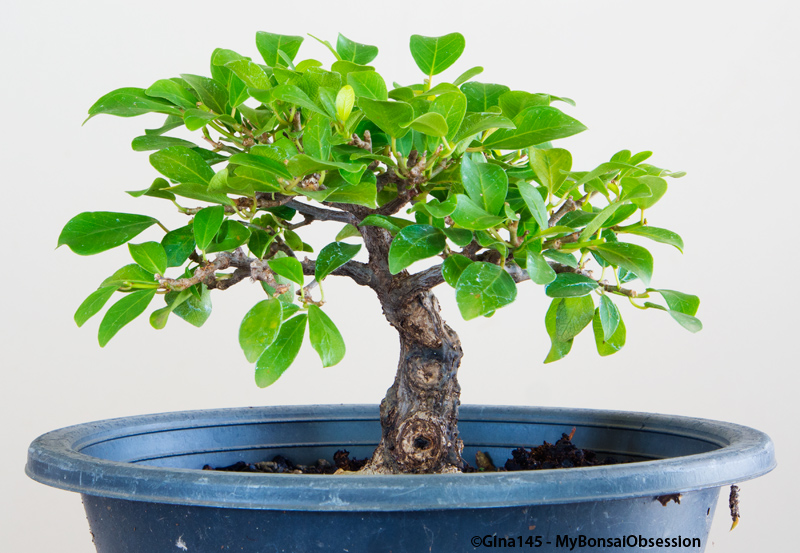
Mother Ficus

Mother Ficus is one of my oldest surviving trees. She's the ancestor of every Ficus Natalensis I own.

I found her in the bonsai section of a local nursery about ten years ago bearing the label "Ficus", with no indication of what variety she was. All I knew was that she wasn't a Benjamina, which was the only variety of Ficus that I owned at the time, but that was enough to convince me that I should give her a home.

She was an ugly little tree with a trunk about the thickness of a pencil and terrible branch structure, and once I'd bought her I didn't really know what to do with her. Back then I didn't know enough about bonsai to have the faintest inkling of how I could improve her appearance. Instead I decided to propagate what proved to be the first of many offspring - the tree which appears in my introductory post and is also the subject of an article which I published at HubPages several years ago.

A few months after I joined my club I decided to see if something could be done to make her look better, so I took her to a workshop. The organiser took one look at her and recommended a trunk chop. Instead of an ugly tree, I went home with a sorry looking stump about three inches high, uncertain whether she'd live or die.

Eventually a few weak buds sprouted at the site of the chop but by then there was far stronger growth coming out of the base of the trunk. This was not what I had expected!

Once more I took her to a workshop.

"That's your tree," I was told.

My teacher was referring to the strong new stem coming out of the roots. I wasn't delighted when he told me to remove what remained of the old trunk, but reluctantly I followed his advice. Now all that remained of the tree I'd bought was the roots.

Eight years later Mother Ficus is happily living in a bonsai pot and has been on show at my club a few times.

Mother Ficus - June 2016

She'll never be a show-stopper but she's a far better tree than I ever hoped she would be. Her biggest weakness is her poor nebari (roots) but hopefully in time I'll be able to fix that too.


Linking up with NF Trees n Bushes.

Wednesday, 22 June 2016

Welcome to My New Home

This blog was born on 11 September 2015.

In early May I began to contemplate moving it to a new domain, so I stopped writing updates. Not blogging about my trees has really been hard for me, but I didn't want to continue until I found it a new home. About a week ago I finally committed to Blogger and slowly started rebuilding my blog.

Right now I'm nearly half way through posting my old content and by the end of June all my old posts should be here, hopefully accompanied by some updates on the trees I wrote about in those posts. And I can't wait to introduce you to some of the trees I haven't written about before.

Monday, 25 April 2016

A Vigorous Olive Tree

In October 2013 my bonsai club hosted a convention attended by members of the bonsai community from all parts of South Africa. The headliners at this convention were three foreign guests, among them an American called Rob Kempinski.

In addition to hearing the speeches, I was fortunate enough to attend one of Rob Kempinski's workshops.

In the build-up to the convention I realised that most of my trees weren't worthy of a workshop of this calibre, and luckily I was able to buy an old olive tree which had been collected from the wild a year or two earlier. This is what it looked like just before the workshop:

October 2013 - before initial styling

At the workshop the best possible branches were selected and Rob Kempinski also did a bit of carving for me, as well as refining the jin at the top with a blowtorch. After the workshop it looked like this:

October 2013 - after initial styling

I then left it to grow for a while so that the lower branches could develop, but did the odd bit of tidying up work as this tree has a tendency to put out lots of buds on old wood.

New buds forming on trunk

I have to remove these regularly, otherwise the entire design of the tree will be lost.

By August 2015 those lower branches had thickened up a fair amount and had been trimmed back so that the tree was starting to resemble a proper bonsai. In addition, a little more carving had been done at my club's workshops.

August 2015

However the tree had one major issue which was really worrying me. As the tree had originally had very one-sided growth, the lowest branch on the left was actually a back branch which had been pulled to the side. It looks okay in the picture above, but from the back it looked really ugly:

Rear branch pulled to side

This is where the tree's tendency to produce lots of buds helped me out. Within weeks after this photo was taken, a new bud had appeared exactly where I wanted it.

New branch forming in front of old one

Once that branch had grown long and strong enough for me to be sure of its survival, I removed the old branch and wired the new one into position, with the tip pointed upwards to encourage it to grow vigorously and fatten up.

After removing old side branch

At the same time I repotted the tree, changing the angle slightly to make the top jin a more dominant apex.


December 2015, after repotting

In February I took it to a workshop where I was persuaded to remove the lowest branch, a decision I still sometimes question.

Lowest branch removed

Hopefully by the time the new branch has fattened up I'll be able to convince myself that it was the right decision.

Repotting the tree in fresh soil seems to have increased its vigour. Despite removing the new buds in both February and March, a month of neglect meant that the whole structure of the tree had disappeared behind a sea of new growth.

Olive tree, overgrown after one month of neglect

After a quick tidy up this week, it now looks like this:

April 2016

Aside from developing the new branch, there is still quite a lot of refining to do. Those pads look quite unbalanced to me, and I can't help feeling that the lower jin is too heavy. As I don't do my own carving it will need another workshop soon.

Updated photos can be found here.

Wednesday, 13 April 2016

In Search of the Perfect Tree

My search began as the result of a visit to Reddit's bonsai group which recently announced that they would be holding a Nursery Stock Contest. During the course of the contest, a period of approximately six months, participants are required to transform an ordinary nursery tree into bonsai.

By rights I should have ignored this contest and got on with reading other discussions of interest. I'm by no means the most skilled in the art of bonsai, so I know that I stand no chance of winning. What's more, last year's winning tree was a Juniper and as a rule I try to avoid working with conifers. And perhaps worst of all, I live in the Southern hemisphere, so the contest runs over my winter - not the ideal time for developing the branch structure of a tree.

So, did good sense prevail? Not a bit. I want to be part of the fun, so I went out looking for a suitable tree.

I soon came across this guy:

Ficus Nitida as purchased, April 2016

It's a Ficus, one of my favourite species. That's a big plus. By my standards it's quite a big tree, one I'm barely able to lift. Unfortunately the low branches are very thin and that thicker upward-pointing branch half way up the trunk was dead. The taper's not great either, but hopefully thickening up those lower branches will help. That's certainly not going to happen within six months though, so this certainly isn't competition material. I bought it anyway.

The next candidate came from my bonsai club which recently held what is known as a New Talent Competition. To be eligible for this competition you must have been a member for less than ten years. I've been a member for just over eight. Each participant is randomly allocated a tiny Juniper Procumbens Nana and given about two and a half hours to style it. Instant bonsai isn't my thing and as I said, nor are Junipers, but I felt I should challenge myself.

This is the tree I received:

Juniper Procumbens Nana unstyled, April 2016

On such a small tree, the branches were rather thin and not very well positioned so I decided to go for a literati. I ended up with this:

Juniper Procumbens Nana after styling, April 2016

Rather late in the day I realised that I should have left more foliage higher up and made the tail a bit shorter, but I was scared to remove any more right now so it looks rather unbalanced. In time I hope to improve on that.

Before the competition I had considered using this tree for Reddit's contest. However it's far too small and insignificant.

I knew I needed to look elsewhere.

Monday I visited another nursery, where I saw a couple of trees that interested me but they didn't feel right for the contest either, mainly due to the fact that I felt I'd want to do air layers before I started styling them. Obviously that isn't possible during the time allowed. I left with nothing.

Tuesday I found a tree I liked somewhere else:

Feijoa Sellowiana as purchased, April 2016

This one's a Feijoa Sellowiana. Not a tree I've often seen as bonsai, but I already have a thicker one which I rather like and I'd been considering buying another for some time.

Once again I'm not really sure this is contest material. Although I'm prepared to cut back hard, I don't see the prospect of much new growth over winter. But I'll start work and see what happens.

After buying this tree I still felt the urge to go back for one of the trees I'd seen on Monday, so this afternoon I went and bought this guy:

Euonymus as purchased, April 2016

It's a rather slender Euonymus which could probably do with a couple of years' unrestricted growth before I start work on it, so I probably shouldn't even consider it for the contest. Thankfully it was really cheap, but it's yet another tree to take space in my overcrowded bonsai area.

And so, while I'm really trying to reduce the size of my collection of pre-bonsai, cuttings and seedlings, over the course of the last couple of weeks I've acquired four new trees. And I'm still not sure I'm even going to enter the contest.


Update: 17 July 2016

In the end I didn't enter the contest because I knew that none of my material was really suitable, but I enjoyed the hunt.

I've started work on the Ficus and the Feijoa, but if I don't lose patience I'm still hoping to fatten up the Euonymus before I even consider styling it.

Monday, 28 March 2016

Ficus Ingens - creating a family of trees

April 2012 - as purchased
This is a tree I bought at a local nursery in April 2012. At the time it was about 3 foot tall and straight as a pole, but it had two things going for it - it had decent nebari (roots) and it was a variety of ficus which I didn't have in my collection. It was also really cheap.

It's a Ficus Ingens, the red-leaved fig. The foliage starts out red, but as it matures, it turns green. The leaves are quite large, but I believe that they reduce well so I'm hopeful that it will make a decent bonsai one day.

I love to propagate my own trees so my first step was to air layer the excess height, which in this case meant everything about the first couple of branches. I'm not sure when I started the air layer, but I'd guess that I waited until the South African spring, so that would have been late 2012.

Ficuses tend to air layer very easily and by February 2013 I was the proud owner of two trees - one long and straight, and this little one on which I could start work developing branches:

February 2013 - after removing air layer


Once the top had been removed the existing branches started to grow well and, despite one trim, by June 2014 it looked like this:

June 2014 - before pruning

At that time I took it to a workshop where I was persuaded to remove the lowest branch, something I now feel may have been a mistake. After some hard pruning, this is what was left:

June 2014 - after pruning

Since then I've pretty much left it to grow, and it currently looks like this:

Current appearance - March 2016

Now I'm starting to wonder what my next step should be. I considered reducing the height but I'm wondering whether I should develop it into a slightly taller tree than I originally planned. I don't want to rush the decision so for now I've done nothing.

Any suggestions would be welcome.

Here's a 360° view:


While the original tree was growing branches, my new tree was fattening up quite nicely but all of its branches were high up, so last summer I air layered a small section off the top in the hope of encouraging more branching lower down. My collection now consists of these three:

The tree and its offspring - March 2016

Despite my efforts the tall one still has no low branches, so this week I decided it was time to start another air layer just above the lowest branch.

New air layer on the tall tree

Now I'm impatiently waiting for roots to develop.

Sunday, 13 March 2016

Breaking all the Rules

I know I've written at length about my fig tree, but I thought one last update would be in order before the Southern hemisphere winter arrives. Already the days are getting shorter and there's a nip in the morning air, so this tree will soon drop all its leaves. I can't see anything changing between now and spring, so you won't have to read about it again until at least September.

This tree has changed a lot over the course of this summer, and most of what I've done has gone against advice I've been given both online and at my club, but that's okay. It's my tree and I'm the only one who has to like it.

December 2015 - before pruning

This is what it looked like in December, before I started work on it. A strange twisty trunk low down with a dead straight top section. My plan was always for a short tree though, and all that height was just to thicken up the apex.

When I took it to my club for a crit just after this photo was taken, I didn't expect any positive feedback, but I did get some, and based on the advice I received, I cut it back to this:

December 2015 - after pruning

It didn't take me long to realise that I hated that as a front, so I started exploring my options, finally cutting them down to three possible fronts before deciding that the one I thought I liked best was probably just a bit too out of the box. All the while I was gradually cutting down on the number of branches, and by the time I took it to a club workshop today, only two remained.

Fig tree - before season's last pruning

I was determined to get rid of one of them, but should have known better than to ask for other people's opinions. Out of all the people I asked, only one agreed with my strange decision, and some even questioned my choice of front, preferring an angle that I dislike.

Sometimes I give in to others' opinions, only to regret it. In this case, however, I was not to be deterred from what I wanted to do. However, after hearing what was said, I did a little unplanned wiring to the leader. I also tweaked the front ever so slightly.

Fig tree - March 2016

In spring I'll repot it again, because I really want to bring it a bit more upright, more or less how it looked when I tilted the pot for this photo.

Proposed angle for repot

That will require a bit of root work though, because there are some really heavy roots at the back. After that I'll leave the side branch to thicken a bit, but I won't let the apex grow too much higher because I'm not planning to let it thicken much more and I really want to start working on ramification.

Friday, 11 March 2016

Clip and Grow Bonsai

An article I read last night indicated that wiring is almost essential to the bonsai process. That's not what I wanted to hear. I try to keep the amount of wiring I do to an absolute minimum.

The reason I dislike wiring is partly down to sheer laziness. It takes a lot of time and patience to wire every branch of a tree, right down to the tiniest twigs. And then there's the need to watch the tree closely to ensure the wires are removed before they bite so hard that they create deep scars which may never heal completely. That becomes a problem when you've got as many trees as I have.

But I've got a better reason. I'm okay with wiring thin branches, but my hands aren't strong enough to cope with heavy wire and even if I succeed in applying it, bending a newly wired branch into the desired shape is often beyond my capabilities. I don't want to become too dependent on the men at my club to do that for me. I'd hate to think that all my trees were the product of someone else's labour. Where's the fun in that!

Followers of the Lingnan School of Penjing grow naturally styled trees using the clip and grow method. I'd like to learn more about the steps they take in the development of their trees, but I'm struggling to find any literature on the subject. It's never been discussed at my club either.

So I've been trying to solve the riddle for myself. I have one little tree that has never been wired:

Ficus Natalensis - March 2016

It's one of the two I discussed in my post Two Ficuses - Bonsai in Training. The second tree in that post has had the two lowest branches wired once to reposition them slightly.

Ficus Natalensis - March 2016

Today I'm discussing a tree which is still in a much earlier stage of development. I'm taking this one really slowly.

Ficus Natalensis - March 2016

It doesn't look like much from this angle, but the good part is hiding behind the lip of the pot.

It's another Ficus Natalensis (indigenous to South Africa), genetically identical to the two above. They're all trees I propagated from either branch or root cuttings. Well strictly speaking this one propagated itself. I'd cut a surface root off its parent tree but didn't remove it from the pot. Having started life in a shared pot, the tree naturally grew at a slant as it reached for light beyond its parent's shadow.

Before I repotted this tree I'd made the mistake of growing most of my trees upright. Fortunately I had the sense to keep this one at its chosen angle.

Ficus Natalensis - December 2012

I'm not sure how long after I separated it this photo was taken, but it must have been a while because it was looking rather pot bound. This was what it looked like after its first pruning, one which I realise with hindsight was rather premature.

I didn't do too much to it for the next year. Then I discovered a photo which I took as inspiration for styling a slim slanting tree. At that stage I picked a new leader, leaving me with this:

Ficus Natalensis - December 2013

The tree, however, had other ideas and soon put out a lot of low growth.

Ficus Natalensis - March 2014

Seven months later it was looking nothing like the tree I'd planned.

Ficus Natalensis - July 2014

By then I had a new idea about where I wanted to go, but I wasn't going to rush things, so I waited another eight months for my new leader to thicken, then made a really drastic chop.

Ficus Natalensis - March 2015

In the last year it's grown quite vigorously and that leader has thickened substantially.

Ficus Natalensis - March 2016

When I brought it inside to photograph it for this post, I removed a couple of unwanted aerial roots and one tiny branch from where there were two growing at the same point. I'm not planning to do anything major until next summer, when I plan to move it to a bigger pot. For now I might shorten some of the top branches to encourage more growth lower down, but that's about it.

My future plans are to do another major chop as illustrated here:

Planned spot for future chop

Before I do that, however, I want both the current and future headers to thicken up a bit more.

Just where it goes after the next chop remains to be seen. As this tree has had a major say in every step I've taken so far, it may well make that decision for me.

I've no idea how long it will take before this tree starts to resemble bonsai, but that's okay. I'm prepared to wait as long as it takes.