Saturday, 23 January 2016

Other People's Ideas

I love going to bonsai workshops. They're a great place to look for new ideas while socialising with people with whom I have a shared interest.

When I joined my club eight years ago, things were slightly different. I needed all the help I could get in terms of style choice.

Since then experience has taught me that styling choices are subjective and that even the most accomplished bonsai artists may make suggestions that I don't agree with. Tastes differ, and life would be dull if that wasn't the case.

My problem has been developing the self-confidence to say no. Slowly I'm learning not to be rushed into any decisions I may regret later - most of the time. Sometimes I still succumb to pressure, but not as often as I used to.

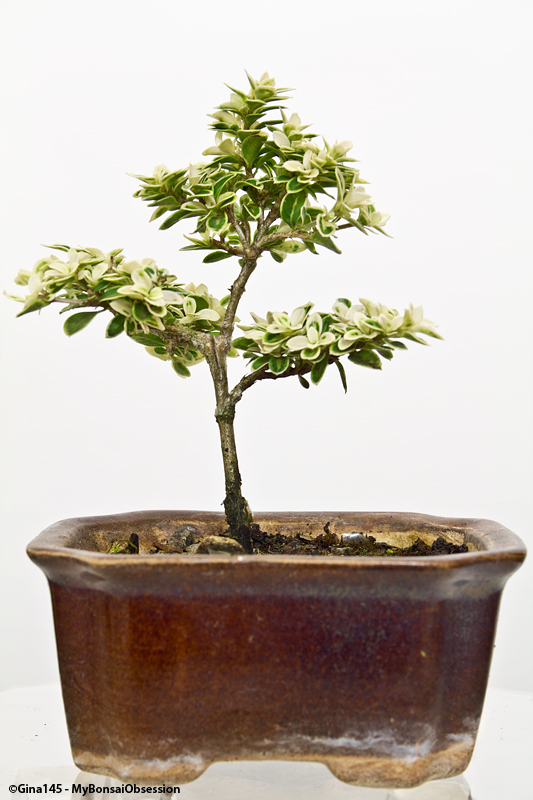
In October 2015 I had the rare opportunity to go to a workshop attended by members of several of the clubs in my province. One of the trees which I took to that workshop was a small Syzygium which I'd air layered off a larger tree about a year ago. I knew it had too many branches but was undecided which ones to remove.

October 2015 - before workshop. The wires were there
 to secure the tree in its pot and were no longer needed.

Had I opted to remove only the lowest branches, it had the makings of a fairly decent broom style tree, but it was not to be.

One of the people at that workshop was a foreign guest. I'd already "met" her on Facebook and seen glimpses of the work she was doing, so when she decided that she wanted to work on my tree I gave her the go ahead.

As it turned out, her ideas were very different to mine and I came away with something that will in time probably become a fairly conventional informal upright tree. At the time the top was very bare, while the lowest branches were left as sacrifice branches to fatten the trunk.

October 2015 - after workshop

Since then it has filled in quite a lot.

January 2016 - before work

Today I decided to bring it inside for a quick tidy up, and not a moment too soon, because some of the wires were starting to bite quite badly.

Scars where wire has bitten into a branch

The branches held their position reasonably well when the wire was removed, so I decided not to rewire the tree for now. Instead I only removed a little unwanted growth from the trunk while it was still young enough not to leave unnecessary scars.

Unwanted new growth on trunk

I left one young twig though because I felt that the tree needed an extra branch in that area. It's got a lot of catching up to do, so I will have to let that one grow unrestricted for quite a while.

Zoomed in to show gap I'd like to fill

I also discovered one small branch which hasn't grown back since it was pruned and is almost certainly dead. Though I haven't removed it yet, I'll probably have to grow a replacement. Fortunately, as I've already shown, Syzygiums tend to produce masses of buds everywhere, so hopefully growing a replacement won't be a problem.

In time this should develop into a nice little tree, but I can't help feeling that it terms of style it will never really be mine.

After removing wire and unwanted growth on trunk - January 2016

Monday, 18 January 2016

Decisions, decisions

I apologise for harping on about my fig tree, but decision-making has never been one of my strengths and I really feel like I need to commit to a front before I go any further with its development.

When last I wrote about it,  I had just done a drastic pruning and defoliation after I repotted it, ending with a naked tree that looked like this:

December 2015 - after pruning and defoliation

Over the last month the tree has put out quite a bit of new foliage on some of the branches, though it still has a few bare patches. But there was enough there for me to feel I could take it to another meeting and ask for more opinions from members of my club, some of whom had not been at the December meeting. Unfortunately the more opinions I got, the more confused I became. Of those who were prepared to offer an opinion, no two people seemed to pick the same angle and I came away with five different fronts to choose from.

Since then I've spent quite a while examining the tree from all angles and even shot a video of it slowly rotating to try to get a more three dimensional view than any photo could show.


After making a few slight adjustments to the angles suggested by my fellow club members, I eventually cut my options down to the three I've marked in the video.

Front 1

Potential front 1

I know this looks nothing like traditional bonsai, but I like the way most of the curves are visible, while the one bend I dislike is hidden away at the back of the tree. The base also looks thicker from this angle than from any other. Some branches will have to be removed, but the same applies to any front I ultimately choose.

Front 2

Potential front 2

The bend I dislike is more visible from this side, but still doesn't look too bad. Watching the video back, I'd probably rotate the tree slightly anti-clockwise if I went with this option.

Front 3

Potential front 3

The more I look at this one the less convinced I become that it's one I'd really consider. The angle at which the curve comes back to the front is problematic because parts of the rear section are visible while others are hidden. And in a two-dimensional photo, they look more like straight lines than like curves anyway.

Branches

As the focus of this tree is on the curvy trunk, it was suggested that I remove all the branches and only grow foliage at the apex. It's an option I'm considering, but the one negative is that it will limit the tree's ability to produce fruit, and I really had hoped that it would give me a fig or two to enhance its appearance in the future.

Friday, 15 January 2016

The Benefit of Experience

I know that I've still got a lot to learn about styling bonsai, but I like to believe that my skills have improved in the eight years since I joined my bonsai club.

One of the lessons I've learnt along the way is that trying to do too much too soon can actually slow down the process in the long run. The tree I wrote about in a HubPages article several years ago is a case in point.

It was one of my first creations, started from a cutting shortly before I joined my club in 2007. With the over-enthusiasm of a newbie I started styling it as soon as it had formed roots, thus limiting its ability to fatten up and condemning it to being rather slim for its height.

Being new to bonsai, I believed that following the rules was essential, so I tried to use the correct branch placement for an informal upright tree but made a very basic error in not growing the base of the trunk at a slant, resulting in a rather unsatisfactory first bend. By the time I realised my error, however, it was too late to do anything about it.

In 2010 I decided that it was ready for a bonsai pot and I proudly put it on display at my club's show that spring.

Once in a bonsai pot its growth slowed down drastically and the branches have never filled in as much as I'd have liked them to.

In bonsai pot - November 2015

In November 2015 I finally decided it was time to do something about that so I moved the tree back into a training pot in the hope that the extra root space would help it to regain some of the vigour of its youth.

Moved to training pot - November 2015

After that I left it to grow freely and it the last couple of months it produced a fair amount of new growth.

Before pruning - January 2016

Today I planned to give it a slight trim to encourage the branches to ramify. However as soon as I got started I realised that most of the new growth was in the wrong place - at the tips of the branches, though on the lowest branch much of the foliage was growing back towards the trunk, disguising an unattractive straight section before the branch first divided in two. There are similar flaws at the top of the tree.

Once I realised that all that growth was doing nothing to help with those flaws I decided to cut back hard in the hope of getting some back-budding to fill in those gaps. For now, after pruning, all those flaws are very noticeable.

After pruning - January 2016

Hopefully the fact that they are now getting a lot more light will help to encourage growth where I really want it. If not, I may need to prune even harder.

At times I've contemplated giving this tree a whole new look but a part of me feels I should stick to the original plan to show how my sense of style has evolved over the years.

In 2010, when I first put it into its bonsai pot, I propagated a new tree from one of its roots. By then I'd learnt to take my time, so I let the new tree grow freely for a couple of years before I cut back the trunk and started developing branches. It is one of the two ficuses I discussed in an earlier post.

Here is a photo of parent and child standing side by side.

Parent and child - January 2016. Child is on the right


The child may be a lot smaller than its parent, but I far prefer its structure, though I sometimes wonder if it isn't a little too tall. But thanks to the experience I gained along the way, the child is much closer to becoming a decent bonsai than the parent is.

Wednesday, 6 January 2016

A Group of Ficuses

I've already written about my first failed efforts at growing bonsai in around the year 2000. One of my first trees was a beautiful variegated Ficus Benjamina which I killed due to excessive defoliation because, to be honest, I didn't have a clue what I was doing.

I was really sad to lose that tree and immediately started searching for one like it without success. For some reason those trees seemed to be in short supply at the time, and after a long search the closest I could find was a group of thin trees growing in one pot.

I didn't have the courage to separate them and had no idea back then that a bonsai planting could consist of more than one tree, so I kept them in my lounge as a house plant and set about growing my own bonsai from a cutting.

Over time the thicker trunks grew long and straggly with a fair amount of delicate foliage while the thinner trunks were so weak that they needed support to keep them upright.

Shortly after I joined my bonsai club I realised that they'd be better off outside. I wasn't too happy when all the sickly foliage got burnt by their first exposure to strong sunlight, but happily they soon put out stronger new leaves and have been growing vigorously ever since.

Eventually they grew so tall that the wind kept blowing them over, so I moved them into my little greenhouse, where they still reside.

As they grew the larger trunks thickened a lot but the lower branches started dying off and by the time I realised that I could turn them into a bonsai group planting, reducing the height left them looking pretty bare.

It's been a while now since their first chop and they've started back-budding in a few places, but they were getting pretty top heavy again, so last week I decided to reduce the top growth. Apologies for the missing photo showing them before pruning, but for some reason I forgot to take one. This is how they look right now.

A Ficus Benjamina group in early stages of training

It's been suggested that I keep them tall, but I'm undecided about their future height. Generally speaking I prefer shorter trees, so I'm hoping that they'll eventually give me some decent leaders lower down. Besides the current leader on the tallest tree looks horrible. Unfortunately it's all I have to work with right now.

My only plan for the immediate future is to get them into a bigger pot, and then all I can do is wait and see what new options they offer me when they start growing again.

Saturday, 2 January 2016

A Flower for the New Year

I've never had much luck with flowering bonsai.

My problems began with one of my first trees, a small Azalea which I bought in the days when I still hoped to keep my trees indoors. As an over-enthusiastic newbie I put it straight into a bonsai pot, and I probably made a few other mistakes that I wasn't even aware of. Needless to say it didn't survive for very long.

On another occasion I bought a beautiful Fuchsia. As far as I recall it was quite a big plant which would have required hard pruning if it was ever to become bonsai, but I never got that far. It too was living indoors and one day it got knocked over. It went downhill pretty fast after that.

Then there was my first Camellia. By the time I bought it I'd realised the importance of light so I put it on a stand next to a large window and hoped for the best. It stayed green for quite a while but I suspect that by the time the leaves started dropping it had already been dead for some time.

Shortly before I joined my bonsai club I bought a small twin trunk Serissa. One trunk died but it recovered well after that setback and started growing quite nicely when I finally learned the error of my ways and moved it outside. I even had hopes of putting it on our club's show, but those hopes were quickly dashed when it received an unplanned restyling courtesy of Mother Nature during a severe hailstorm in December 2007. Though that didn't kill it, it finally died tragically in the great vinegar disaster. Not before I'd propagated a few more baby Serissas from cuttings though.

In 2011 I developed one of those cuttings into a mame tree (or to be more precise a tiny stick in a pot) which I was persuaded to put into a bonsai pot long before it deserved to be in one.

A tiny Serissa bonsai, 2011

Shortly afterwards I foolishly decided to put that tree on display at a show our club was holding at a local mall. It was by far the smallest tree on show and on the Saturday it was admired by several members of the public who didn't realise just how little character it really had.

I arrived at the show on the Sunday morning to be greeted by the news that my little tree had been stolen. As the venue was frequented by wild young people who came there to party the night away, I suspect the thief crept into the fenced-off bonsai area on a dare and looked for the easiest tree to carry. If that's the case I doubt he even tried to keep it alive.

In financial terms the loss of the pot was probably a lot more significant than the loss of the tree, and in terms of time and effort I didn't lose much either, but I still mourned the probable death of the baby of my collection.

There have been a few more disasters over the years and I also have a few flowering trees with little bonsai potential. And then there's my dwarf Pomegranate which is developing quite nicely but refuses to give me a single flower or fruit.

All of which brings me to New Year 2016 and a chilli seedling that a member of my club gave me a few months ago.

Chilli seedling with its first flower (top right)

I hadn't been giving it too much attention as my focus was purely on keeping it alive, but when I was watering my trees yesterday I noticed that it was celebrating the new year with its first flower.

Close-up of flower on chilli seedling

My friend is trying to create a chilli bonsai by fusing a bunch of seedlings into one tree. I only have the one which he rejected because its growth pattern didn't fit into the group. One of these days I'll have to move it into a bigger pot and see if it can develop enough of a trunk to create a small bonsai.

For now I'm having fun turning its photos into digital art for my new photo blog at Tumblr.


Tuesday, 29 December 2015

Sometimes I get carried away

Some of the experts at Reddit's bonsai group have accused me of doing too much too soon and I have to admit that I'm often guilty of that. While some of my trees can sit in my bonsai area for months or even years without my doing much work on them, some get more than their fair share of attention.

I'm trying to improve my bonsai skills though so, since becoming aware of the problem, I've been trying to restrain myself where possible. Despite that I sometimes find myself getting carried away once I have a branch cutter in my hands.

In a recent post I wrote about an odd little Ficus Benjamina I've been working on. Although it's not traditional bonsai, I had fun creating it. After its last haircut it was looking quite good, even if a couple of branches didn't feel quite right to me, and I even had thoughts of finding a bonsai pot for it.

That was over two months ago though, and it was starting to look rather overgrown again, so a couple of days ago I decided to bring it inside for a little trim while I watched the South African cricket team in action. I didn't plan anything drastic, just to tidy the top up a bit.

Before pruning

Perhaps part of the blame could go to my team's poor performance, or maybe that's just a lame excuse, but I suddenly decided that those branches had to go. Somewhere along the lines I also concluded that the tree was too tall, so I reduced the height as well. By the time I was done, my poor little tree was reduced to a mere skeleton with a few leaves on each branch.

What's left after excessive pruning

I'm not sure whether to be embarrassed by what I've done. Part of me feels like I've done something awful, but I'm also curious to see what new growth the little guy puts out during the rest of the Southern hemisphere summer. Who knows, in time it may still become a better tree.

One thing is certain though - that bonsai pot will have to wait!

Saturday, 26 December 2015

Two Ficuses - Bonsai in Training

Today I present you with two trees that I've been working on for a while. They're one of my favourite species - Ficus Natalensis, a tree indigenous to South Africa.

Two overgrown ficuses - bonsai in training

To the bonsai newbie it may come as a surprise that these "bushes" have already been in training for a few years, but after a quick haircut all will be revealed. Ficus Natalensis is a vigorous grower and most of the excess foliage is this season's growth.

The tree on the left was grown from a cutting - a small branch I removed from one of my older trees several years ago. The one on the right started its life as an unwanted root from the tree I used as the subject of an article I published at HubPages a few years ago. It was propagated when the parent tree first went into a bonsai pot in October 2010.

Both trees were allowed to grow to several times their current height before their training started and once looked similar to this tree which I plan to discuss in a future post:

Another tree in an earlier stage of development

I don't believe in wasting anything that can grow, so the tops of both have since become trees in their own right.

But back to today's trees. First the tree on the left.

Before pruning

Ficus Natalensis has a tendency to put out aerial roots which can sometimes find their way into unexpected places as can be seen in this photo from my post on two other ficuses which I had neglected for some time. A root from one tree grew across the gap into the other tree's pot.

Overgrown roots

In the right place, aerial roots can be desirable, but the one I found on this tree was not.

Unwanted aerial root

It had to go.

Next I got down to shortening branches. I need to be very selective when it comes to pruning this tree as I've been growing it using the clip and grow method, denying myself the option of wiring branches to correct their position. Growing bonsai this way can be quite challenging and, while I try not to do more wiring than necessary on my other trees, I do use some wire on most of them.

With more than half the foliage removed, it looks more like a little tree, though I don't feel it's ready to go into a bonsai pot just yet. I'll let it grow for a few months now, and then I'll repeat the process.

After pruning

On to the second tree.

This one was not quite as simple as I thought it would be. As it was growing too low in its pot to photograph properly, I decided to take it out of the pot while I was working on it. As it turned out, the roots were all at the top and when I lifted it, most of the soil was left behind.

Removed from old pot

Under the circumstances I decided to repot it properly.

That proved to be a wise decision because below the fine rootage there was a big fat root growing in circles. It probably grew like that while it was still in the smaller pot it started its life in. I removed that root and planted it in its own pot to see if it will grow.

As my tree clearly didn't need so much soil, I moved it into a shallower pot.

Repotted and waiting to be pruned

After that all that was required was a rough haircut, with a little caution required because there was a spider lurking between the branches.

Repotted - after being pruned

I'm embarrassed to admit that I potted it at a bad angle, and had to adjust that after this photo was taken, but I guess the photo gives a fair idea of how the tree looks right now. After pruning it is approximately eight inches high, excluding the roots. In time I may reduce the height further.

This one will be spending the next couple of weeks in the shade while it recovers from its root surgery. The other tree is already back in the sunny spot it calls home.


Linking up with Inspire Me Monday.